WC.com

Tuesday, August 14, 2018

Details on 2018 Claimant Fees

Recently, in 2018 Fees and Settlements (August 2018), this blog provided a brief history of Florida workers' compensation attorney fee evolution, 2018 aggregate claimant attorney fees, and an overview of the reasonably consistent recent history of both settlement order volume and settlement aggregate dollar value. This post continues the examination of 2018 claimant fees, with an analysis of the contributions of various fee categories or groups to the overall total. 

Over the four fiscal years 2015 through 2018, attorney fees related to the settlement of Florida workers' compensation cases averaged about 62% of the aggregate total of claimant fees. The non-settlement fees contributed 38%, which was comprised of 9% non-hourly and 28% hourly fees. 


The data reported for each of those years individually, however, demonstrates changes in the contributions each element makes to the aggregate. In 2015 and 2016, attorney fees on settlements accounted for a larger majority of claimant attorney fees. Those two years documented similar figures in all categories: settlement $96,073,314 to $94,422,599 - settlement fees decreased in  2016; non-settlement, non-hourly fees $17,882,330 to $16,285,382 - the non-hourly fees decreased in 2016; non-settlement, hourly fees $22,281,761 to $25,866,295 - hourly fees increase in 2016. However, the overall total claimant fees for the two years were remarkably similar: $136,237,414 (2015) to $136,574,237 (2016).


The aggregate, or total claimant attorney fees increased notably in 2017, from $136,574,237 (2016) to $185,676,766, an increase of almost 36% in one year. There is the suggestion that some portion of that increase should be related to the pent-up supply of fee agreements. Anecdotally, some attorneys voiced an intention to hold fee entitlements in fiscal 2016 in anticipation of a decision in the then-pending Supreme Court review of Castellanos v. Next Door Company, 192 So.3d 431 (Fla. 2016). And, the composition of parts contributing to that aggregate also changed. 

Settlement fees remained the predominant category in 2017 and increased slightly from $94,422,599 to $99,066,123 (+5%). Non-settlement fees contributed more significantly to the increase, although the non-settlement, non-hourly fees decreased notably (though as a percentage, perhaps "significantly" is more apt) from 16,285,382 to $11,256,726 (-31%). The increase in non-settlement fees was in the hourly category, which increased from $25,866,295 to $75,353,918 (+191%). 

In 2018, the overall aggregate total of claimant attorney fees increased by almost 7%, from $185,676,766 to $198,653,393. Fees in two categories decreased in 2018. The volume of non-settlement, hourly fees receded from $75,353,918 to $70,013,393 (-7%). The contribution of non-settlement, non-hourly fees decreased in a reasonably consistent fashion, from $11,256,726 to $10,570,867 (-6%). The increase in 2018 is attributable to settlement fees, which increased from $99,066,123 to $118,069,209 (+19%).

The various contributions of these categories are perhaps easier to visualize when expressed as percentages of each year's respective whole. 


This diagram illustrates that the 2018 composition of claimant attorney fees is somewhat divergent from the four-year averages illustrated in the first graph: settlement 62%, non-settlement hourly 29%, and non-settlement, non-hourly 9%. In 2017: settlement 53%, non-settlement hourly 41%, and non-settlement, non-hourly 6%. In 2018: settlement 59%, non-settlement hourly 35%, and non-settlement, non-hourly 5%. Considering that neither the volume of settlements nor the aggregate dollar value of settlements is demonstrating significant changes in either 2017 or 2018, claimant fees on settlements appear to be accounting for a greater amount of the settlement funds. 


That conclusion may be supported by an examination of the distribution of the fee percentage in settlements (above). Virtually all settlement fees are calculated as a percentage of the settlement amount. in both 2015 and 2016, almost 99% of Florida workers' compensation settlement fees ranged between 1% and 20% of the settlement amount. That is consistent with the statutory requirement for application of the 20%/15%/10% formula in Section 440.34, F.S. 

However, in 2017, that 1%-20% fee range decreased to just over 90% of the settlements; in 2018, it decreased more significantly to about 66%. Notably, every settlement fee in a workers' compensation case (remembering the caution of the Estupinan potential discussed in 2018 Fees and Settlements, August 2018) must be approved by a Judge of Compensation Claims. As the data supports a significant (over 33%) volume of approved fees inconsistent with the statutory formula, it appears that some populations are ignoring that formula. 


The non-settlement attorney fees can be further subdivided into categories. The Florida OJCC has five categories for such fees: Order Approving Stipulated Appellate Attorney Fee (OASAAF), Order Approving Interim Attorney Fee (OAIAF), Order Awarding Contested Attorney Fee (OACAF), Order Awarding Contested Appellate Attorney Fee (OACAAF), and Order Approving Side Stipulation with Settlement (6). However, two of these account for just over 94% of the non-settlement fees: OAIAF and 6. I have always wondered what led the programmers to abbreviate that one "6." But, if it isn't broken, don't fix it?


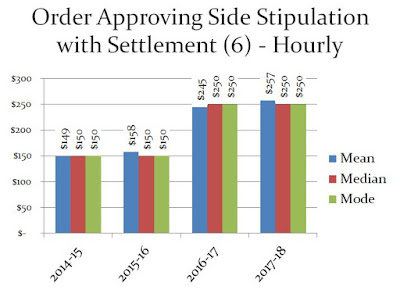
Of course, any of those five might be either "hourly" or "non-hourly." Analysis of the hourly fees in these categories is perhaps worthy of understanding. The hourly rates in these categories can be calculated and compared from one year to the next. This demonstrates regarding OAIAF that in both 2015 and 2016, there were distinctions between the three methods of calculating "average": (1) mean (add all and divide by volume),  (2) median (the number value that is in the middle of a range examined), and (3) mode (the number value most often represented in a data set). In 2017 and 2018, these three calculation methods have yielded significantly consistent results. 


The analysis of Order Approving Side Stipulation with Settlement (6) does not illustrate the distinctions among various methods of quantifying "average." Some will note that the average hourly rate in both categories demonstrated an increase from 2016 to 2017, and the averages are all reasonably consistent comparing 2017 to 2018 in both of these predominant fee order types. 


Claimant attorney fees in Florida continued to rise in 2018. Hourly fees' contribution to the overall total decreased some, while settlement fees increased significantly. This is despite the overall volume of settlements and the aggregate settlement value remaining remarkably stable. There is significant indicia that some population of Judges of Compensation Claims either interpret the District Court's decision in Miles as a determination that Section 440.34 F.S. is facially unconstitutional or otherwise find legal justification for disregarding the provisions of that statute related to settlement attorney fees. 


Sunday, August 12, 2018

2018 Florida Fees and Settlements

There has been an interest in attorney fees in Florida workers' compensation, seemingly as long as I can remember. My history in this industry certainly is not even close to that of some of our community icons, a handful of whom have remained in this practice since the late 1960s and early 1970s. However, I recall discussions of fees throughout much of my career. 

Some historical overviews may be helpful. Workers' compensation came to Florida in 1935 in Chapter 5966. The Florida community today readily short-hands its "comp" references to "440," the statutory current home of our workers' compensation law. Many do not realize that is not the statute chapter in which comp originally resided. The original statute included a very brief section on attorney fees; it essentially said any fees had to be approved by the "commission." As an aside, some readers may not realize that most of the Florida workers' compensation laws are available in PDF on the "resources" tab of the OJCC website

Over time, statutory provisions regarding fees were defined and constrained. The word "reasonable" was added, as was a provision affording a fee avoidance (if benefits are provided within 21 days). The Florida Supreme Court weighed in back in 1968 with Lee Engineering v. Fellows, 209 So.2d 454 (April 10, 1968), judicially legislating 6 factors relevant to a determination of "reasonable." The separation of powers discussions that can involve Fellows are intriguing. 

In the 1970s a claimant fee formula (percentages) was added, a process for splitting fee liability among employee and employer, and eventually, a "bad faith" fee standard was codified. Later years brought a thirty-day window for employers to provide claimed benefits without fee liability, and adjustments to the formula fee, which had become colloquially known as the "statutory fee" in common parlance. 

The Lee Engineering "factors" were codified, more than once modified, and interpreted. What had been a "presumptive" fee formula purportedly became mandatory in 2003. Litigation ensued, and in 2008 Murray v. Mariner Health, 994 So.2d 1051 (Fla. 2008)(October 23, 2008) clarified that the formula remained suggestive but not binding. That effort at statutory construction was seen as strained by some. The legislature in 2009 rendered the formula mandatory again. That set the stage for more litigation, and 2016 brought the decisions of the First District in Miles v. City of Edgewater Police, 190 So.3d 171 (Fla. 1st DCA 2016)(April 20), and the Florida Supreme Court in Castellanos v. Next Door Company, 192 So.3d 431 (Fla. 2016)(April 28).

As screenwriter and director Dee Rees once said "History informs where we are and how we got here." The foregoing is admittedly brief, certainly cursory, and admittedly merely an overview of history. But, it is perhaps an acceptable "nutshell" version of "how we got here," and find ourselves again discussing Florida attorney fees in 2018. This post will focus on what Office of Judges of Compensation Claims data demonstrates regarding attorney fees. Future posts will focus on other statistical reporting, including petition volumes and more. 

Castellanos and Miles were each decided late in 2016 (Florida operates on a fiscal year, which ends each June 30. Thus, it is possible that these two 2016 decisions impacted 2016 statistics, but only late, in the last 60 to 70 days of that year. Anecdotally, there were those who claimed to have postponed attorney fee agreements or claims in 2016, awaiting or anticipating appellate court decisions. Thus, there is some belief that a "reservoir" of claims had accumulated by the time the two appellate decisions were rendered. The aggregate of claimant attorney fees awarded and approved in 2016 were very consistent with those in 2015.


In 2017, however, the aggregate increased about $49M, which was almost 36%. Since that increase was published, many have wondered or prognosticated aloud regarding whether that increase represented the resolution of some portion of the purported "reservoir" or perhaps portended a trend to increase. The answer to that perhaps lies in future data compilation and evaluation of whether the trend to increase continues. Some may argue that the more modest 2018 increase, a moderation of the trend to increase, supports the "reservoir" supposition. 

In 2018, the aggregate claimant attorney fees in Florida increased another almost $14M, almost 7%. Caveat, these figures are aggregated and calculated in the process of preparing the statutory annual report each fall. Much work remains in that process, and these figures are subject to change as audit processes continue. The figures in the chart above for both 2015 and 2016 (italics) were slightly adjusted this year when minor accounting errors were corrected. 

In sum, aggregate claimant fees in Florida continued an upward trend in 2018. Some may point out that 7% is far different from 36%. Others may comment that 7% is significant and might cite recent news that a 4.1% rate of growth in American domestic product ("GDP") was hailed as significant by various commentators. Still others may reference that aggregate claimant fees in 2017, despite that $49M increase, remained about $68M less than aggregate defense fees. And, a few will question why 2018 defense fees are not included in this post (defense fee reporting for 2018 will not close until September (Rule 60Q6.124(6)), and unfortunately final calculations are not usually completed until October.

There is some notable consistency in the 2018 data compared to the data for the previous three years. One example is the aggregate paid in approved settlements. Those figures have been notably consistent.


Most settlements of workers' compensation benefit entitlement will be known to the Office of Judges of Compensation Claims. There is the potential, however, for certain entitlements for those represented by counsel to be addressed through other agreements, as discussed in Patco Transport, Inc. v. Estupinan, 917 So.2d 922 (Fla. 1st DCA 2005); but see Cabrera v. Outdoor Empire, 108 So.3d 691 (Fla. 1st DCA 2013) regarding unrepresented workers and waiver of benefit entitlement. I am periodically surprised in discussions when attorneys express unawareness of the potential Estupinan impact. 

Similarly, there is fluctuation in the number of settlements approved each year, but the trend is also similarly one of notable consistency. This is also subject to the same Estupinan caution. 


Thus, the number of settlement orders being entered (whether approving fees and child support - where the worker is represented, or approving the actual settlement - where the worker is not) has varied. However, there is notable consistency year after year. For clarity, the graph above depicts "represented settlement volume." The figures for unrepresented settlements, however, are similarly consistent: 2015 - 1,478; 2016 - 1,359; 2017 - 1,379; 2018 - 1,356. 

The 2018 data thus far demonstrates notable consistency regarding the volume and aggregate dollar value of Florida settlements. The aggregate value of claimant attorney fees increased in 2018 for the second consecutive year, post-Castellanos and Miles. The rate of increase has moderated, but may nonetheless be characterized as "significant" by some. The claimant fee aggregate for 2018, despite two years of increase, remains significantly below the defense fee aggregate for 2017 (calculations later this fall will perhaps provide further perspective).

This discussion is continued in Details on Claimant Fees

Thursday, August 9, 2018

Maybe it is that Hard to Understand?

I was somewhat surprised recently to read the headline State says Massie campaign appears to lack workers’ comp insurance in the Boston Globe. Massie is seeking to be the Governor of Massachusetts. The Globe notes that if successful, Massie would "oversee a sprawling 43,000-employee bureaucracy." That is a great many employees in any context. 

The story reports that the Office of Labor and Workforce Development concluded that the campaign "does not currently appear to have a workers’ compensation policy in place. " Upon that conclusion, the Office referred the campaign for investigation and "further inquiry.” According to the Globe, the Office "averages about 6,800 workers comp investigations every month that typically result in about 170 stop work orders." 

The Globe further reports that “all employers in Massachusetts must have workers’ compensation insurance to cover their employees,” according to a state website. Another website clarifies that in Massachusetts: 
The (insurance coverage) requirement applies no matter the number of hours worked or the number of employees.
The only exception is for domestic employees who must work at least 16 hours a week to be covered under a workers’ compensation policy. 
That is an interesting point. As noted in The Gig Economy - Can It Be Socialized (March 2018), many states have coverage requirements that are dependent upon the size of the employer. In Florida, participation in workers' compensation is mandatory when an employer has four employees (or one employee in the construction industry). Some states have a variety of specific exceptions that list occupations that are not an "employee." Florida lists the following among those exempt from participation in workers' compensation: 
"independent contractors," “real estate licensee,” “musical and theatrical performers,” owner-operator of a motor vehicle” “person whose employment is both casual and not in the course of the trade, business, profession, or occupation of the employer,” “a volunteer,”persons who serve in private nonprofit agencies and who receive no compensation,” “exercise rider,” “taxicab, limousine, or other passenger vehicle-for-hire driver,” “a sports official for an entity sponsoring an interscholastic sports event." 
Thus, one might conclude that the coverage requirement in Massachusetts is more pervasive than in Florida. Massachusetts appears to offer only very limited exceptions, for domestic help working part-time, to the broad requirement that workers' compensation coverage must be provided for all employees regardless of the "hours worked or the number of employees." 

Thus, in Massachusetts, it may be easier for an employer to determine when coverage is required. However, in other states it may be a more difficult analysis dependent upon understanding the actual role and function of those performing work, and conclusions as to whether each is or is not an "employee" contributing to that "four or more" parameter upon which the requirement of coverage depends. 

In this context, it is important to remember that workers' compensation is a subject of state law, explained in Territorial Jurisdiction in Comp (May 20. In the course of the 2016 National Conversation (January 2018) on workers' compensation, there were multiple references to the challenges that are encountered because state systems have different requirements. That group noted "regulatory complexity," "system failures," "misclassification" "federalization" and "competition between states" as challenges that complicate the workers' compensation world. 

Returning to Massachusetts, the Massie campaign contends that volunteers are not employees. The Globe reports that a Massie email explains the absence of coverage stating that "his campaign has taken steps to transition from a 'largely all-volunteer campaign staff to our current state of operations.'” The implication was that workers' compensation coverage was not a requirement for volunteers, but became an issue when the campaign transitioned to a team of fourteen paid staff. 

That conclusion regarding employees was seemingly echoed by another candidate, Scott Lively. Mr. Lively noted that "his campaign does not have any employees," and that in Massachusetts, "a sole proprietor is not required to carry workers’ comp insurance, so long as they work alone." 

Thus, the requirements and parameters are seemingly somewhat more extensive than reflected on the Massachusetts website: 
"The (insurance coverage) requirement applies no matter the number of hours worked or the number of employees." 
It appears instead that the "number of employees" is relevant, in that businesses with only one (sole proprietor) employee need not have coverage. And, it appears that "volunteers" are not counted as employees in Massachusetts. 

The complications are potentially more pervasive. Candidate Massie also told the Globe that he believed he had procured workers' compensation coverage. He claims to have hired a "payroll processor" to handle all of the complexities of compliance, tax withholding, etc. His comments suggest he may have believed that the contractual relationship included workers' compensation coverage. There are arrangements referred to as "employee leasing" in which such coverage is in fact included in the contractual relationship. 

The end result is illustrative. Employers face the challenge of determining whether their business is required to have workers' compensation coverage. The requirement to provide compensation is generally on the employer, as is the obligation to "secure" that obligation through insurance. An employer who fails to "secure" coverage may nonetheless find itself liable to an injured employee. The absence of insurance will not be a shield to liability. That is an important point for employers to note and remember. 

Employers may require expert advice and assistance in the process of these questions, considerations, and decisions. Generally, insurance brokers and agents are reasonably prepared to offer advice on the "if" and "how" questions of workers' compensation coverage. Generally, employee leasing companies are as prepared to offer employers advice regarding various options. However, there are potential situations in which an employer might be well advised to seek competent legal counsel before proceeding. 

A certainty is that "I did not know" is a poor answer when caught without coverage. Further, "I thought someone else was taking care of it" will be of little assistance. Interestingly, this subject makes the news in this instance because it involves a high-profile candidate for public office. But, it is useful to learn from this headline. Workers' compensation is there to protect and care for employees when the unexpected happens. Employers have the obligation to seek advice, become knowledgeable, and to comply with the law. 

This remains true regardless of the nature of the employment, the public profile (or lack) of the employer or its principals, and the complexity of the law involved. Regardless of any of this, it is the employer's obligation to understand and comply with the mandatory participation requirements of the jurisdictions in which they provide work.


Tuesday, August 7, 2018

What is a Claim? Let's be Accurate

A recent blog post regarding workplace injury caught my attention. It was titled Florida's Workers' Compensation Laws Fail Workers (originally published on prweb.com. This headline was followed by the assertion that
"According to the United States Department of Labor, workers in Florida have filed 7,792 workers' compensation claims so far this year. More than 50% of those claims -- 3,967 -- have been denied, according to the Department's Office of Workers' Compensation Programs."

The link in that quote leads to the Florida Division of Workers' Compensation home page, not to any specific Florida data or reporting. There is no link provided to the U.S. Department of Labor, the purported source of the volume of "claims" at 7,792. The post was published on July 24, 2018. It struck me initially that is not clear whether the post's reference to "this year" is to the fiscal year 2019, which began July 1, 2018, or calendar year 2018, which began January 1, 2018.

ABC7 republished the blog, labeling it a "press release," with the same headline. It appears that republication did not involve any editorial review or checking of the facts or headline asserted. 

A search of the Florida Division of Workers' Compensation Claims Database, reached through the link provided by the blog post, revealed that 21,324 "total cases" have been documented in Florida since January 1, 2018. The Division's search tool does not afford an opportunity to search date ranges except using the January 1 start date and December 31 end date (calendar years).


A similar query of the Florida Division database yielded "total cases" totals between 56,000 and 63,000 in each of the ten years before January 1, 2018. It is difficult to understand how the total volume as of July 2018 could be 7,792 as reportedly stated by the U.S. Department of Labor. And, that led me to investigate further. 


As a side note, the represented Florida case figure for 2018 thus far (21,324) is seemingly not consistent with the annual volumes over those ten previous years. If the 21,234 figure for 2018 were "annualized," upon the premise of this total being gleaned with seven months of the calendar year now concluded, then the "total cases" for 2018, the total for "this year," might be anticipated to be something less than 37,000 (21,234/7 months = 3,046; 3,046 x 12 months = 36,556).

The Florida Division database does not provide a search function for gleaning the volume of "claims" (that) have been denied. The figure for this "denied" represented by the cited blog post for 2018 claims is 3,967. The absence of any database for that on the Florida Division page also caused me curiosity. 

I reached out to the author of the blog and was provided a link to the data relied upon in the post regarding "claims," and was provided a link to the U.S. Department of Labor. This DOL page explains that last year the DEEOIC (Division of Energy Employees Occupational Illness Compensation) implemented new case management tools, and provides data REGARDING ITS CLAIMS. This is related to a federal program that was enacted in two parts noted, "Part B" and "Part E." 

Part B was enacted in 2000 and is for employees of the Department of Energy and specified others: 
"who were diagnosed with a radiogenic cancer, chronic beryllium disease, beryllium sensitivity, or chronic silicosis, as a result of exposure to radiation, beryllium, or silica while employed at covered facilities" 
Part E was enacted in 2004 and compensates Department of Energy contractors, miners, millers, and specified others: 
"for any occupational illnesses that are causally linked to toxic exposures in the DOE or mining work environment" 
The statistics regarding the volume of claims "in Florida" as stated in the blog quote: 
"According to the United States Department of Labor, workers in Florida have filed 7,792 workers' compensation claims so far this year. More than 50% of those claims -- 3,967 -- have been denied, according to the Department's Office of Workers' Compensation Programs." 
are related to the "combined Part B and E." In short, the quoted statistics are related to people engaged in work covered by two federal programs. The quoted data regarding these claims is related to Florida only in that these federally employed, federally insured, employees are in, or filed their federal claims in, Florida. The cited Department of Labor data has nothing to do with Florida workers' compensation. 

The blog post's headline Florida's Workers' Compensation Laws Fail Workers is thus inaccurate, misleading, and unsupported. This indictment headline impugns the Florida workers' compensation law and its workers' compensation system and provides no relevant data in support. And, despite the implications of the headline, it might be impractical to even determine a rate of "denial" for Florida "claims."

It is possible that one might calculate the volume of "claims" in Florida. However, before any Florida statistics were quoted, I would suggest that definition(s) would be of assistance. That is the point in the initial question titling this post: "What is a claim?"

"Claim" could mean that an accident/injury is reported to the Florida Division of Workers' Compensation, see section 440.185, Florida Statutes. That is the "case" data from the Florida Division.

Or, one might only count those instances in which benefits are not voluntarily provided for such injury, that is when litigation is filed, which is referred to as a "new case" in the Office of Judges of Compensation Claims (OJCC) vernacular. That filing would be a "petition." Back when the Florida Supreme Court was creating rules for Florida workers' compensation, it enacted a rule that defined "claim" as "any element of a petition for benefits (PFB) or other entitlement," see former Rule 4.020; see also Amendments to the Florida Rules of Workers' Compensation Procedure, 829 So.2d 791 (Fla. 2002). 

As of August 6, 2018, there had been 18,934 "new cases" filed with the OJCC thus far in calendar year 2018. Some of those "new cases" were established because an employee or employer wants a procedural decision made by a judge (motion determined, settlement considered, etc.). Others were established because an employee feels she/he is entitled to some benefit that is not being provided and they seek a hearing to prove entitlement.

Moreover, when the situation is one of seeking benefits (filing a PFB), that PFB might seek one benefit (and thus perhaps be described as containing one "claim"). Or, that PFB might seek several benefits and thus be described as containing some other number of "claims."

Thus, depending upon the definition of "claim," there could be a variety of answers: accidents reported, petitions filed, new cases filed, or all the individual requests in those various petitions. Each definition of "claim" would likely yield a different answer.

When the employer or its insurance carrier receives that PFB, it might acquiesce in some claim(s) and deny others. It notifies the injured worker of that decision(s) through filing a "response to petition, or "RP"). And, if the employer or carrier changes its mind about something in the RP, it may file another RP describing that change. The number of RP might be readily determined, but determining how many "claims" or issues were "denied" would likely be a bit more elusive. One might have to read each RP to determine if it could be accurately termed a "denial."

Thus, there is a published headline that impugns Florida, and it is unsupported by Florida data. The post provides federal data, while inaccurately implying that data is somehow related to Florida workers' compensation. The result is misleading. The effect is unfortunate. 


Sunday, August 5, 2018

#MeToo Workplace Implications

Eyes are upon the Fourth Circuit as it considers the reporting of workplace harassment. The case is Ray v. International Paper Co. According to Reuters Legal (pay site), there will be oral arguments in September. The plaintiff contends that a "supervisor supervisor propositioned her, made lewd comments, or offered her money for sex" on a "weekly basis beginning in 2003." She complained of the activity in 2014. The defendant investigated those claims in 2014 and found them "meritless."

The plaintiff filed a lawsuit in federal court complaining of the harassment and alleging that her overtime hours were diminished after she voiced her complaints (retaliation). The defendant responded with its conclusions of the accusations being meritless and also complained about the delay in reporting the alleged supervisory behavior. The judge agreed and dismissed the suit concluding: 
"it was unreasonable for her to wait for years to complain, and the delay absolved the company of any liability under Title VII of the Civil Rights Act of 1964."
Ray is asking the 4th Circuit to essentially "revive" her complaint and direct the trial court to proceed with hearing it. There is precedent for such revival, according to Reuters Legal, which cites a Third Circuit decision recently in Minarsky v. Susquehanna County. Ms. Minarsky was allegedly the target of "unwanted sexual advances" for several years. However, she similarly did not report the conduct. Eventually, an investigation led to the termination of the supervisor. Her lawsuit seeks damages from both the supervisor and from the employer. 

The Third Circuit reversed the dismissal of Ms. Minarsky's lawsuit. It concluded that there are multiple factual issues in the allegations, which require determination. The Court held that (1) "whether the County took reasonable care to detect and eliminate the harassment," and "whether Minarsky acted reasonably in not availing herself of the County's anti-harassment safeguards" were both issues of fact that a jury would have to determine. 

Ms. Minarsky worked with the defendant for almost 4 years. The complained of behavior came to the attention of management when she confided it to a friend and when a coworker noticed one incident. Ms. Minarsky eventually wrote an email describing conduct, asking the supervisor to stop, and advising she was uncomfortable. She testified that she knew he had been previously "reprimanded unsuccessfully," and that statements he made about her work made her fear her job could be eliminated. From these, she concluded not to report the supervisor. 

The county then fired the supervisor. Then, "several years later" Ms. Minarsky quit the job. She alleges that she was uncomfortable working for that supervisor, and remained so after the supervisor was fired, due to "inquiries from her new supervisor" regarding his conduct and the reason for his termination. 

The Third Circuit explained the proof required for a harassment claim under Title VII: 
"1) the employee suffered intentional discrimination because of his/her sex, 2) the discrimination was severe or pervasive, 3) the discrimination detrimentally affected the plaintiff, 4) the discrimination would detrimentally affect a reasonable person in like circumstances, and 5) the existence of respondeat superior liability." 
And, it explained an "affirmative defense" that has been described by the United States Supreme Court in two decisions, and which is referred to by a combination of the names of the plaintiffs in those cases, the "Faragher-Ellerth Affirmative Defense." It may result in avoiding employer liability despite the proof above if the employer can prove: 
"(a) that the employer exercised reasonable care to prevent and correct promptly any sexually harassing behavior, and (b) that the plaintiff employee unreasonably failed to take advantage of any preventive or corrective opportunities provided by the employer or to avoid harm otherwise."
The Court explained that a critical point in this analysis is "reasonableness." It conceded that the employment relationship may mean that "a supervisor's power and authority invests his or her harassing conduct with a particular threatening character." Thus, the employee may well be in a position of inequality generally and may feel threatened specifically, even in the absence of a stated, direct, threat. 

The trial judge determined that the employer "exercised reasonable care to prevent the behavior and that Minarsky's silence was unreasonable. The plaintiff was unwilling to report the harassment or to avail herself of the policies and processes that the employer had in place for just such behavior. The trial judge concluded that "prolonged failure to report" is "unreasonable as a matter of law." 

The Third Circuit found fault with both of these trial judge conclusions. First, it held that the pattern of behavior at the employer, and the knowledge of management, supported the conclusion that the county "seemingly turned a blind eye toward Yadlosky's (the supervisor) harassment." Therefore, the Court held that (a) would be a fact question in this case. Second, the Court held that remaining silent may be "objectively reasonable in light of the facts pleaded. Based upon them, a jury might or might not find reasonable Minarsky's failure to report, that (b) is likewise a fact question. 

Of critical import in Minarsky, the Court acknowledges many instances in which the "outright failure to report persistent sexual harassment is unreasonable as a matter of law." But, the Court "clarified" that "a mere failure to report one's harassment is not per se unreasonable." Thus, this case is not an appellate prohibition upon trial court dismissal but instead will require judicial consideration of both the intensity of the facts presented and the reasonableness of the explanation provided. 

It is important to remember that an appellate court's logic and holding are "binding" (must be followed) in that particular court's geographic jurisdiction. Outside of that area, the opinion is what lawyers call "persuasive" (may be followed, but not necessarily). The Third Circuit (Minarsky) is comprised of Delaware, Pennsylvania, New Jersey, and the Virgin Islands. The second case, which is set for oral argument in September (Ray), is in the Fourth Circuit, which is comprised of Maryland, North Carolina, South Carolina, Virginia, and West Virginia, The Fourth is not bound to follow the logic of Minarsky, and so lawyers, businesses and more will be watching for that conclusion. Minarsky is arguably not the law in other parts of the country as of today, but lawyers may well argue that other Circuits adopt its logic.

It is possible that the Fourth Circuit will disagree with the Third Circuit. In the event that occurs, it may be that this is "unreasonable as a matter of law" except when it isn't analyzed will end up under consideration at the U.S. Supreme Court. It is not uncommon for that Court to consider cases that illustrate a legal "conflict," that is where one or more Circuits reach interpretations that are inconsistent with the conclusions/interpretations of one or more other Circuits.

The implications are thus legally interesting. However, the case is interesting because it provides insight into the work environment and the responsibilities of employers in both noticing and dealing with harassment.


Thursday, August 2, 2018

If it is MOOT, what does it Matter

In early June I penned When There is a Different Judge (June 2018). This outlined the authority of a judge to return to previous decisions of a judge formerly assigned to a case. Just prior to that, this blog documented some "dumb mistakes" (May 2018) at the hands of a law student representing himself in federal court in Miami. That post explains briefly how extraordinary writ jurisdiction of the courts may be invoked. 

Essentially, appellate courts are courts of error. They exist to review the decisions of trial courts. To do so, for the most part, appellate courts follow standards of review. These are parameters within which the law and decisions are analyzed. By sticking to the standards, appellate courts provide two important functions. First, they homogenize the law across great geographic distances. This makes the law the same in Pensacola as it is in Jacksonville. Second, they bring consistency to the law; with consistency comes predictability, and parties are thus empowered to both predict their outcomes and rationally resolve their disputes. 

That does not mean that courts do not abandon their role periodically. They do. That is discussed in Abuse of Discretion (June 2018). 

The upshot of all of this was recently reinforced when the Florida First District Court rendered its decision in Chaviano v, Greater Miami Caterers. This is not an appeal (in which the outcome of a trial is disputed, and errors of the trial court are asserted), but an extraordinary writ. Three such writs are worthy of note: mandamus - asking the appellate court to order the trial court to do something; prohibition - asking the appellate court to order the trial court not to do something; and, certiorari - asking the court to review some action prior to the conclusion of the trial process or otherwise outside of the standard review process, often because of perceived great need or potential for significant prejudice. 

Chaviano is a case of prohibition. A Judge of Compensation Claims was asked to remove him/herself from three cases by an attorney. The attorney alleged the judge had demonstrated bias against the attorney or the attorney's clients. The assigned judge entered an order denying the disqualification, and the attorney filed the petition for a writ of prohibition. These writs are called "extraordinary" for a reason; they seek relief immediately when relief might nonetheless otherwise come with the passage of time. In other words, it is possible the clients might prevail at trial, despite the attorney or party's perception of bias. If the party prevailed at trial, then that might itself demonstrate that there was no actual prejudice. 

Despite that potential, prohibition is an appropriate procedural course. A judge is removed from a case with a recusal (the judge takes her or himself off of a case with no request from a party) or disqualification (the judge grants some party's motion to remove her or himself from the case). Unfortunately, these two words are often used interchangeably through apathy or shallowness of analysis. The contention in prohibition in this context is the fear of not receiving a fair hearing and the potential that great resources and time could be invested in the trial of a case, only to then appeal the outcome based upon the error alleged in the bias perceived. Thus, prohibition is seen as a less costly methodology for sorting the bias allegation before the feared error occurs. 

In this instance, the prohibition was somewhat unique, however. First, three motions were filed seeking the judge to be removed from three cases. The trial judge entered an order denying one. The other two were not addressed by the point in time that this particular trial judge left the bench. The trial judge, whom the client or attorney perceived as biased, ceased to be a judge. As the person was no longer a judge, that person would no longer be presiding over the trial or making decisions. That person, if he or she was biased, would not be able to apply that bias to the party or the attorney.

A great many people would conclude that this departure from the bench was essentially a solution to the attorney and client's perceived problem. Some might posit "I wanted this judge off this case, the judge is now off of this, and all cases, problem solved." But, the attorney in this instance did not. 

Procedurally, after the petition for writ of prohibition had been filed in the District Court, the Court "stayed proceedings." This process, a "stay" made it impossible for the trial judge to proceed further with the case. However, after that trial judge left the bench, seemingly alleviating the potential for prejudice to the party or attorney, that stay remained. Such a stay precludes further proceedings by the "lower tribunal." Though a replacement judge had been appointed that new judge was likewise precluded from proceeding, precluded by that stay.

The petitioning attorney knew, and acknowledged to the Court, that the trial judge had departed. The attorney even went so far as to state "The issue of the prior JCC's refusal to grant Petitioners' motion for disqualification is now moot." However, the attorney did not dismiss the petition for writ. As a result, the stay remained in effect. 

Acknowledging that the disqualification is moot, the attorney nonetheless sought to have the appellate court proceed with its extraordinary review of the case. Essentially, the attorney alleged that various actions or rulings of the (now) prior judge, the bases for the fears of bias or prejudice, should be reviewed by the appellate court on the now-moot petition for writ. Certainly, it is possible for an appellate court to review procedural orders that occur before the conclusion of a trial, called "interlocutory orders." The request for such review is by "certiorari." Admitting the prohibition was moot, the attorney essentially asked the Court to instead review those interlocutory orders by certiorari. 

The attorney asked that the Court review all of the interlocutory orders and decisions and then return the case to the trial level, to the newly assigned judge, and instruct that new judge to begin the process over. The attorney asked the Court to order the new judge to reconsider and rule upon each and every procedural decision made in the case to that point. The request was to reverse and invalidate all procedural decisions and to start over, called "de novo," and so that with such a reversal and instructions "all perceptions of bias and taint is removed for good" in the case. 

The Court found this request for relief worthy of comment. It stated "it is difficult to understand" the lawyer's request. The Court noted the prohibition is moot (as the attorney admitted) and that this "should end the inquiry." (citation omitted). Stating the obvious, perhaps in hopes that blunt can be clear, the court said "the fact that the prior JCC will no longer preside over Petitioners' cases renders a petition to disqualify him unnecessary." Unnecessary, moot, and of no import. 

The Court declined to revisit all of the interlocutory orders. It reminded us that prohibition is "preventative, not corrective." The prohibition is to prevent harm from occurring, not to review and correct prior decisions. As the judge had departed and no longer could adjudicate the case, there was no need for any prohibition. The Court reminded prohibition is to prevent future action and "should not be used as a substitute for an appeal." (Citation omitted). 

Finally, the Court reminded that "the current JCC is not bound by orders of the prior JCC." This echoes the discussion in this blog regarding When There Is a Different Judge. In so holding, the Court cited different authority than the blog post, but the import is the same:
"[p]rior to fmal judgment, a successor judge has the power to vacate or modify a predecessor's interlocutory rulings"

"a nonfinal or temporary order may be revisited by a judge at any time before the conclusion of the case, even by a successor judge"
Of course, any order or decision of the new judge may nonetheless be reviewed by an appellate court after the case is heard and decided, by "appeal." As certainly, allegations of bias might be raised in a particular case about a newly assigned judge, in a new and separate motion to disqualify or petition for prohibition. But, the prophylactic, prohibition, process is not the appropriate method for proceeding in this factual setting, against a judge who has departed and can no longer adjudicate any issue in the case. 

As an aside, it is worth noting that in this instance the purpose of prohibition has been frustrated. The point of prohibition is to sort the bias issue without the expense and delay of proceeding through trial. In this instance, the parties have experienced months of delay and the delivery of justice has been frustrated. Money has been spent on the appellate process, only to be reminded that moot issues are not adjudicated by appellate courts and that interlocutory orders can be reviewed by a successor judge. Months and money invested in reminders of what to some may seem obvious. 

The lesson for attorneys and others may be a simple question. If it is moot, and everyone admits it is moot, then ask yourself "what does it matter?" If there is no sound answer to that question, it may be time to dismiss the petition and get on with the business of trying the case with the new judge.


Tuesday, July 31, 2018

Big Data in Health Insurance?

National Public Radio (NPR) is sounding the alarm regarding big data. It reported on a recent gathering of health insurance professionals in San Diego last June, in Health Insurers Are Vacuuming Up Details About You — And It Could Raise Your Rates. I mentioned the story and its implications to a few recently, trying to gauge their impressions. Reactions ranged from "That's alarming" to "NPR is always sounding an alarm about something." Some take NPR as undeniable truth and others simply do not find it credible. Only you know where you are on that spectrum.

But for the sake of argument, its reporting may at least provide a foundation for discussing the implications of data harvesting and privacy. The news has been full of privacy stories recently. Revelations about who has access to our information, and to whom they are selling it, have become a commonplace staple recently. In response, the Europeans have tightened privacy, as has California. Privacy, it seems, is a serious concern to many. 

According to NPR, there is a potential for health insurers to make decisions based on "social determinants of health." It contends that it is not only possible, but practical for everything you buy, eat, or do to be monitored in the modern world. NPR contends that information such as education level, marital status, gender, and race might all be known to your health insurer. Facts such as gun ownership, gym membership, what magazines you subscribe to, and how often you change jobs might also be of interest. And, it asserts that all of that data might be used to "help determine how much you pay for health insurance."

NPR says that industry (data brokers who collect and then sell your details) "are tracking your race, education level, TV habits, marital status, (and) net worth." In our digital age, all of this information is apparently reasonably easy to accumulate, aggregate, and dissect. We voluntarily use loyalty programs at retailers, trading some anonymity for a discount on some products. We shop online and allow those retailers to know much about us based on what and how often we purchase. 

Those are perhaps reasonably obvious. But, NPR contends that more subtle things may also be used. For instance, a woman with a name change might signal a new marriage that some database could equate to a probability of "a pricey pregnancy," or alternatively "maybe you're stressed and anxious from a recent divorce." Is our weight changing (buying larger clothes)? Is our income level increasing or decreasing (implicate our food or fitness choices)? Are we a minority? What are the characteristics of our neighborhood? NPR contends that these and more might be stereotyped and used by supercomputers.

Potentially, all of these and more have implications for our health. Or, they may just somehow be linked with healthiness in some computerized analysis. They may predict what health issues we are likely to face. Of course, from a separate set of data, insurance companies are already familiar with the costs and variants of treating such potential health issues. Thus, knowing the cost of an outcome, and predicting the likelihood of that outcome are two important variables in an equation predicting cost. That prediction might mean we can buy coverage or not, and it could affect price.

NPR's perspective is that there appears no denying that insurance companies are accumulating and using data about us today. It explains that some companies admit they are doing so, and explain that their use is benevolent. They say that by studying the person, they may "spot health issues," and thus be prepared to assist their clients "so they get services they need." Some companies are reported to currently decry that such data would be used in determining the pricing decisions regarding health insurance. However, it appears that some believe that such implications are at least possible. 

Our immediate reaction may be that our health data is protected. There are federal and state laws that protect our medical records. Anyone who has been to the doctor is familiar with the raft of forms that must be signed regarding those records. I even met a patient once who had attempted to read all of those forms before signing (sarcasm). Truly an ambitious undertaking. However, NPR warns that the data being employed is not from our health records. It contends that instead data is being harvested from public information available on the Internet. 

There are multiple concerns in the pricing debate. First, there is concern, discussed above, that personal information would be used in setting prices based upon assumptions as to the manner in which the way we live might be predicted to impact our health. Second, there is a concern that some information gleaned about us from the Internet might be inaccurate about us individually (there was a funny parody ad that featured people concluding you can't put anything on the Internet that is not true - too funny). Third, there is concern that anecdotal relationships between fact and prediction may be inaccurate presumptions about larger populations. And, finally, there are those who see the potential for discrimination based upon this information. 

Well, in case you did not know, car insurance companies have discriminated against people for years. Gender has been a fact that they consider in setting rates. As a result, it is likely that a female will have lower automobile insurance rates than a male. In fact, CBS News Miami recently reported that a Canadian changed gender, from male to female, to enjoy the insurance savings that comes from the assumptions insurance companies make about gender and driving. Might someone change their identity otherwise in pursuit of savings?

NPR explains that there are various companies involved in this "data mining" business already. Some are large and others just beginning. Reportedly, one already has data sets encompassing "150 million Americans going back to 1993." And, they are purportedly monitoring your social media, gathering data on you from your online interactions, searches, and interests. 

There are those who believe insurers will use this landslide of data to sift and select those that it will insure. NPR calls this "cherry picking," and asserts that insurance companies have practiced it "historically." It suggests that this practice will continue, but that the available data in both breadth and depth will enhance the manner in which, and perhaps the success of, the selections are made. 

I have written about the implications of Ross, AI and the new Paradigm Coming (March 2016). Artificial intelligence is intriguing. Once relegated to the back bench of science fiction, AI is rapidly becoming science fact. Ross is a legal research tool built on the IBM Watson foundation. Remember Watson beat humans on Jeopardy some years ago? NPR reports that IBM is using the same learning, evolving, artificial intelligence to assess socioeconomic factors for insurance companies. 

The implications of such tools may give us pause. It might be used to identify people who present significant loss risk. However, the analysis might instead focus on demographic or geographic groups who are seen as either injury or disease-prone. NPR quotes one source suggesting that living in the wrong place could cost you money. That thought reminded me of Elaine (Seinfeld) struggling to have food delivered from a particular restaurant. Remember when she asked a man if she could use his apartment to fool the restaurant into delivering to her? Might one conceal their address to similarly affect insurance pricing?

Some of this data connectivity may seem pretty obvious. For example, someone who purchases cigarettes might find it more challenging to buy health insurance. But, as these databases grow in both the volume of people tracked and the health outcomes observed, a variety of changes might be seen. For example, it may turn out that people who subscribe to the New York Times are seen over a period to be more or less likely to require various medical supplies, visit some particular type of specialty, or undergo some procedure. That relationship between reading material and health consumption may be at once entirely accurate and entirely coincidental. However, some logarithms may nonetheless conclude that reading the Times is (good or bad) for your health, and adjust pricing accordingly.

NPR says that it will spend the coming months addressing various aspects of this developing story. It will be curious to watch, regardless of your perspective on NPR and its cohort ProPublica. Whether you are inclined to trust these or not, the subjects of privacy and data harvesting are real. There is indisputable, admitted, evidence that things like gender have influenced insurance decisions in the past. Thus, the real questions likely do not include "Will information about me be used to determine coverage and cost?" The real questions, instead are more likely: (1) which data, (2) how much data, (3) how accurately, and (4) how appropriately, "will information about me be used."

Some may conclude that this is all innocuous and mundane. For my part, I am retreating with the Luddites. I am reverting to only cash purchases, in person, in small stores. I am eliminating my Internet footprint, closing my online shopping accounts, and canceling all of my subscriptions. And, maybe I can figure out a way to know who is reading this blog, and sell that information to some supercomputer data broker somewhere?

Sunday, July 29, 2018

Equal Protection in the Bluegrass State

In March, the Kentucky Court of Appeals rendered a consolidated opinion in three cases (each involving a claim against a mining company), collectively styled Napier v. Enterprise Mining, ____ SW3d _____, Case No. 2014-CA-001473-WC (Ky. Ct. App. 2018). It is a panel decision in which three appellate judges concurred (Kramer, Clayton and Nickell). 

The cases "present(ed) a common equal protection constitutional challenge to a statute that provides for "compensation for occupational hearing loss." The statute refers to the American Medical Association Impairment Guides, and requires that any hearing impairment be expressed as an "impairment of the whole person." If the resulting impairment is less than 8% to the body as a whole, then but the benefits do not include "income benefits." The Court concluded that this distinction "violates equal protection guarantees established in the Fourteenth Amendment to the United States Constitution, as well as specific sections of the Kentucky Constitution. 

Physicians assigned Mr. Napier "a 4% impairment rating" regarding his hearing loss. The assigned administrative law judge (ALJ) concluded that the indemnity statute distinction violates the equal protection clause, following a Kentucky Supreme Court decision in Vision Mining, Inc. v. Gardner, 364 S.W.3d 455 (Ky. 2011). Upon rehearing, the ALJ conceded that she/he lacked "authority to determine statutory constitutionality," and therefore did not award indemnity benefits. The Kentucky Board (an administrative body to whom parties may appeal an ALJ decision) concluded it also lacked that authority regarding constitutionality and therefore affirmed the ALJ decision. The other two injured workers whose appeals were consolidated with Mr. Napier's similarly did not meet the 8% impairment threshold. 

It is worthy of note that in the testimony regarding another worker, Mr. Feltner, an expert addressed a related issue pertinent to America's discussion of the interrelationship of "impairment" and "disability." She opined that the "impairment" defined in the Guides to Permanent Impairment for Mr. Feltner's injury "inadequately evinced his substantial functional loss and occupational restrictions." In a broad analysis, there are instances in which an "impairment" may result in the entitlement to benefits despite no resulting loss of wage earning capacity and others in which the loss of wage earning may be more profound than is compensated by an "impairment" calculation. This disconnect has been debated in various contexts and jurisdictions. 

There was further testimony that "varying levels of hearing loss can impact individuals differently." That is, a specific loss of hearing acuity for one person, and the resulting impairment may present greater "functional difficulties and workplace impediments" for one individual than for another. The point is, again, that "impairment" is not the same as "disability."

The constitutional challenges in Napier were founded on two bases: (1) that hearing loss claims have a threshold (8%) that is not consistent with the absence of threshold for other traumatic claims (worker with hearing loss treated differently than worker with back injury), and (2) that those with less than 8% impairment are arbitrarily treated differently than workers with an 8% impairment from hearing loss. In both arguments, the foundation is what the law calls "disparate treatment," that is people similarly situated being nonetheless treated differently. 

The Court quoted Cain v. Lodestar Energy, Inc., 302 S.W.3d 39 (Ky. 2009), holding that "[t]he 14th Amendment to the United States Constitution requires persons who are similarly situated to be treated alike." It noted that workers’ compensation statutes "are presumed to be valid" and compliant with the 14th Amendment "if the classifications that they create are rationally related to a legitimate state interest." 

The Napier court concluded that the law imposes "different statutory treatment for awards of PPD income benefits." It noted that the AMA Guides provide "estimates that reflect the severity of the medical condition and the degree to which the impairment decreases an individual’s ability to perform common activities of daily living, excluding work." It concluded that the Kentucky legislature, enacting the reliance on such Guides, "understood impairment and disability are not synonymous." Further, the Guides themselves state they “were designed to reflect functional limitations and not intended to measure disability.” 

The Court concluded that establishing the threshold of 8% "segregates all traumatic hearing loss claimants into a special class, isolating them from all other traumatic injury claimants." That is, all hearing loss cases are thus tested, and so all are treated differently than other types of claims. It further agreed that the threshold "erects a wall of separation between two subclasses of hearing loss claimants," those who meet the 8% and those who do not. In each instance, the statute treats workers differently. The Court noted that in enacting this 8% distinction, the legislature was silent regarding the justification for such disparate treatment. 

The Court explained that disparate treatment alone is not dispositive of the analysis. The second factor for consideration is whether the classes of workers thus created "are similarly situated." The Court concluded that in both instances, hearing claims versus other injuries and hearing claims under versus over the threshold, "are in all relevant and consequential respects similarly situated." 

The decision includes a discussion of the history of Kentucky Supreme Court vacillation. In 1994, that court concluded that an "irrebuttable presumption of total disability for coal miners’ pneumoconiosis" was not a violation of equal protection. In Kentucky Harlan Coal Co. v. Holmes, 872 S.W.2d 446 (Ky. 1994), the court held that statute favoring injured workers in one industry over those in another industry to be constitutionally sound. However, "seventeen years later," the same court discerned "no rational basis” for the disparate treatment based upon specific industries. Vision Mining, Inc. v. Gardner, 364 S.W.3d 455 (Ky. 2011). Analogizing to those decisions that treat certain employers differently under the law, the court in Napier drew a parallel analysis to Vision, the most recent opinion of the Kentucky Supreme Court.

Finally, the court addressed the Kentucky Legislature's reason for creating this distinction for various hearing loss claims. The analysis in this regard is "whether the differing treatment" is "rationally related to achieving a legitimate state interest." The court concluded that "Vision Mining is dispositive regarding this issue." It quoted that decision, and its explanations for its reversal of Holmes, essentially attempting justification by labeling Vision Mining as presenting a "first challenge." The Vision Mining court purportedly responded to a new and different argument of constitutional infirmity than that previously raised. Some will see that logic and others will refute it. Kentucky's record regarding stare decisis has been discussed here before (October 2015).  

The court concluded that "by denying PPD income benefits to those failing to reach its heightened impairment rating threshold (8%), the statute improperly affords governmentally sanctioned separate and unequal treatment to a subclass of hearing loss claimants." The court stated "it is disingenuous to suggest the heightened impairment rating threshold in KRS 342.7305(2) offsets any greater dishonesty, inability, or incompetence among physicians evaluating occupational hearing loss, and any such suggestion “encapsulates the very meaning of arbitrariness, irrationality, and unreasonableness.” 

Of course, some readers will find the outcome axiomatic. The conclusion may be seen as akin to "of course, the law cannot arbitrarily treat people differently." However, the Kentucky Supreme Court's vacillating analysis between Holmes and Vision may suggest that courts will sometimes sanction discrimination, at least for a time. 

Others may instead question whether there are other statutes that are similarly discriminatory. For example, in 2018, the Florida Legislature passed Senate Bill 376, discussed at length in I'm Just a Bill - PTSD in Florida (March 2018). This bill will become law on October 1, 2018, and elevates "first responders" for different treatment under the law. It does so not by amending the Florida workers' compensation law, but instead by adding language to section 112.1815, Florida Statutes, which changes benefits for first responders "notwithstanding" the provisions and limitations of the workers' compensation law. This bill is not the first such beneficial provision. First responders in Florida are already treated differently than all other workers as regards various cardiopulmonary claims. 

A hypothetical PTSD example might be of assistance. Last Valentine's Day, a student was accused of entering a Florida high school and killing 17 people and injuring multiple others. A Broward Sheriff's deputy on the scene elected not to enter the school to confront the shooter, which itself generated significant news coverage. When the shooting was over, and the shooter had fled the scene, students, teachers, and staff evacuated the scene. Evacuees lost friends and peers in the violence. Some of those evacuees likely saw their dead and wounded friends and peers as they exited. That experience is undoubtedly traumatic, emotional, and devastating.

The wounded were transported to local hospitals where triage nurses, emergency room doctors, surgeons, and other staff encountered them and their wounds. Employees of the medical examiner likely had to visit the school to retrieve the deceased. Someone had to later enter that building to repair physical damage and clean the results of the violence. Teachers and staff later had to return to work at that school. Thereafter, Senate Bill 376 was passed and will soon become law; benefits for PTSD injury to first responders will be statutorily different than for other Florida workers. 

I have heard people question "What if such an event occurred after October 1, 2018, with identical facts?" There is curiosity about whether the police officer (first responder) who did nothing to stop the attack might nonetheless be eligible for benefits for PTSD based on his observations following the event. There are questions as to why that worker would be potentially entitled to such benefits that would perhaps be nonetheless denied to the teachers, janitors, and other school staff who worked through, responded to, survived after, and returned to work after the attack. Some have suggested that treating first responders differently amounts to "disparate treatment" and is therefore not appropriate under the equal protection clause of the United States Constitution, similar to the Kentucky court's Napier conclusions. 

In that context, there have also been those who voice similar concerns with the manner in which first responder benefits for heart disease are seemingly treated differently from the illness of other workers. Some posit that the presumption in favor of compensability for firefighters, police, and others creates protections that they enjoy but that other workers do not. 

At conferences over the years, I have heard attorneys opine regarding the first responder benefit enhancements. It is safe to say that there does not appear to be a consensus regarding these enhancements and the Equal Protection Clause. That is not surprising as the Equal Protection Clause is a complex and difficult analysis at times, which is evidenced by the fact that the Kentucky Supreme Court has struggled even to agree with itself regarding the appropriate interpretation. 

Whether any constitutional infirmity actually exists, of course, will be unknown unless a challenge is raised in the courts. Like Kentucky, the Florida workers' compensation trial judges (JCCs) have no authority to conclude a statute is unconstitutional. Thus, any such challenge might be raised before a Judge of Compensation Claims for the purpose of obtaining testimony and other evidence (the "record"), but any decision on a constitutional question would be for the First District Court on appeal. 

In the meantime, such questions are perhaps merely interesting to think about or to discuss over a glass of iced tea at the annual workers' compensation conference in Orlando.