WC.com

Tuesday, July 24, 2018

Makes you Think (Hopefully)

There is a song by the Corries called The Bricklayer song. It dates from 1969, when it was written by Pat Cooksey under the title "Sick Note." According to PatCooksey.com, the song was popularized in Europe by various singers under the two titles. However, in America, it was performed under the titles "Dear Boss" and "Why Paddy's not at Work Today." I first came across it in a note some years ago.

As an aside, for the Millenials and Next-geners out there, social media has been around for eons. It was not invented recently, merely digitized. In the "good old days," things of interest were passed from person to person on a media we called "paper." These "papers" were often pinned to a framed piece of cork on a wall, which we called a "bulletin board." Often when we found something of interest on such a board, we would take the paper and put it into a "copier." We would then keep the copy and put the original back up. 

Make no mistake, the content of some of those pages was offensive, insulting, and inappropriate. In that manner, not that different from today's social media. It was read, discussed, copied, and redistributed. Significant time in the workplace was devoted to sharing and talking about such documents, little different from today. But, it was sometimes much harder to trace that material to a source; today postings leave digital "fingerprints," but back then you would have had to find actual fingerprints and found the time to trace them. 

The point with that recognition (or for some a revelation perhaps) is that the world is not necessarily any different in character today. Certainly, information may move more rapidly, and may spread more readily, but that distinction is about speed and convenience. Information has been around for a long time. It has always spread (in the real "old days" it was merely repeated over garden fences and across pub tables in what was called "gossip"). The first time I ran across The Bricklayer Song, it was in lyrics on a bulletin board in an industrial break room. I surmise it was placed there not to make fun of injury, but to remind people of workplace danger. 

Humor is difficult. What one finds humorous, another may find insulting. A word may be uttered appropriately by one person, but its use by another is found offensive. Subjects may be acceptable in one context and taboo in another. Society in the 21st century is seemingly increasingly polarized. Individuals and groups are struck by words and thoughts, sometimes these disappoint and perhaps more often they offend. 

Is it possible to be lighthearted about a subject without offending someone? There is some perception it is not. Several years ago at a football party, a commercial for an insurance company ran. It featured cavemen and their portrayal was not flattering. A fellow guest turned to a group and proclaimed "it's this political correctness, they can only make fun of a group that no longer exists." That comment led to an interesting discussion that centered on why any group is so isolated, attacked, and belittled. Why does humor so often focus on the perceived weakness of some person or group?

But, in a simpler time (or perhaps a time when people were simpler), The Bricklayer Song was contrived (the full lyrics are restated below, courtesy of Metrolyrics). It may be troubling to some, who could perceive it as making light of work injuries. It may be making light of injury, safety, or even intelligence. But it may also merely be making light of human nature. See, whether we want to admit it or not, we all make errors and mistakes. 

We forget things periodically. Sometimes it is something simple like a seatbelt, or a safety line. Other times it may be more involved like a "lock out - tag out" process. We know we are responsible for keeping ourselves safe, but we are imperfect in both thought and action. That is a consequence of our very nature as humans. These thoughts came to me when The Bricklayer Song was reminded to me by a recent email. The sender suggested it would be suitable for a blog, and thus here you are. 

I commend the lyrics to you. I understand that they make light of someone being injured, but encourage instead focus upon them making light of human imperfection. We all face challenges, we contrive solutions, we deal with supervisors, and we make misjudgments and mistakes. Those are often no big deal, we realize we forgot to buckle up when we arrive and reach out of habit to unbuckle. Other times, our mistakes may lead to injury, ours or someone else's. 

Perhaps The Bricklayer's song's value can be seen there, reminding us of our fallibility. Perhaps it can remind us that we are not perfect while it cajoles us into avoiding errors and injury. Read the lyrics, and listen to the band. Accept it as a commentary on, a protest of, work injury. If it offends, you have my apologies. If it reminds you of how simple it is to make mistakes, then you are welcome. The lyrics:

Dear Sir I Write This Note To You To Tell You Of My Plight
For At The Time Of Writing It I'm Not A Pretty Sight
My Body Is All Black And Blue, My Face A Deathly Grey
And I Write This Note To Say Why I Am Not At Work Today

Whilst Working On The 14th Floor Some Bricks I Had To Clear
But Tossing Them From Such A Height Was Not A Good Idea
The Foreman Wasn't Very Pleased He Is An Awkward Sod
And He Said I Had To Cart Them Down The Ladders In Me Hod

Clearing All These Bricks By Hand It Was So Very Slow
So I Hoisted Up A Barrel And Secured A Rope Below
But In Me Haste To Do The Job, I Was Too Blind To See
That A Barrel Full Of Building Bricks Was Heavier Than Me

And So When I Untied The Rope The Barrel Fell Like Lead
And Clinging Tightly To The Rope I Started Up Instead
I Shot Up Like A Rocket, And To My Dismay I Found
That Halfway Up I Met The Bloody Barrel Coming Down

Well The Barrel Broke Me Shoulder As To The Ground It Sped
And When I Reached The Top I Banged The Pulley With Me Head
But I Clung On Tightly None With Shock From This Almighty Blow
While The Barrel Spilled Out Half Its Bricks Some 14 Floors Below

When These Bricks Had Fallen From The Barrel To The Floor
I Then Outweighed The Barrel And So Started Down Once More
But I Clung On Tightly To The Rope My Body Racked With Pain
And Halfway Down I Met The Bloody Barrel Once Again

Now The Force Of This Collision Halfway Down The Office Block
Caused Multiple Abrasions And A Nasty Case Of Shock
But I Clung On Tightly To The Rope As I Fell Towards The Ground
And I Landed On The Broken Bricks The Barrel Had Scattered Round

Now As I Lay There On The Ground I Thought I'd Passed The Worst
But The Barrel Hit The Pulley Wheel And Then The Bottom Burst
A Shower Of Bricks Rained Down On Me I Didn't Have A Hope
As I Lay There Bleeding On The Ground I Let Go The Bloody Rope

The Barrel Now Being Heavier So Started Down Once More
It Landed Right Across Me As I Lay There On The Floor
It Broke Three Ribs And My Left Arm And I Can Only Say
I Hope You'll Understand Why I Am Not At Work Today


Sunday, July 22, 2018

Confusion and Disconnects in Medicine

If we are involved in an accident, we each would want the best care possible, delivered as expeditiously as possible. There will be instances in which we will make medical care decisions for ourselves and other situations in which decisions will be made for us. It is the circumstance in which our decision-making may not follow our personal routine.

In our day-to-day, we make decisions about consumption based on our available resources and the price of goods and services. We act, generally, in our own best interest in those decisions (you tend to buy the car you want or like, not thinking of whether fellow Americans were employed building it). Though we are likewise consumers of medical care, there will be decisions that we will not make. One of the great challenges in our medical care system seems to be that the person needing the care (you) has become too detached from the decision-making. 

For example, you may purchase health insurance, or you may decline. You decide whether that product provides you value in exchange for your money. A great many do not perceive value, and thus elect not to purchase; as a result, they may later find themselves with medical bills they will not pay, and that cost is passed to the rest of society. Those who do purchase insurance may cede some or all of their choices in medical care to that insurance company. It may dictate the physician's choices, testing, and care provided. 

A second example is incapacity. We may, through events or disease, lack the capacity to make medical decisions. In those instances, firefighters, paramedics, doctors, and nurses may make decisions for us. In doing so, they will likely focus entirely on the goal of alleviating our medical symptoms, and pay little or no attention to cost. Thus, through contract for insurance or through circumstance, we consumers may be detached from the decisions that are normal for us in other circumstances. 

An example that has been in the news recently is medical transportation. When an accident occurs, there is developed a tendency to "encourage" care. I recently heard an acquaintance recount the aftermath of a vehicle accident. The collision reportedly occurred after being stopped at a light. Neither car exhibited any damage (no scrapes, dents, or scratches). However, a passing driver perceived stopped traffic and summoned authorities. When they arrived, the two drivers had exchanged insurance information and were about to depart, having concluded there was nothing to this event. 

However, responding police and ambulance personnel questioned both drivers. Photographs were taken, and a report was generated. And, before the conversations were over, my acquaintance had signed a document written in tiny print, "knowingly" waiving medical care or attention. Before signing, the ambulance crew had reportedly reminded my acquaintance repeatedly that both an ambulance ride and emergency room services would be "free." The other driver, moments before being ready to depart and forget this non-event, was instead talked into being transported to the emergency room by the ambulance crew.

At this point in recounting the story, a medical provider in the group noted that it was likely best to get a medical evaluation despite perceptions regarding lack of injury. Another in the conversation decried the crew's repeated persuasion as unnecessary and inappropriate "pressure." A lawyer then interjected that the crew was merely following instructions and that such entreaties and forms were likely ambulance company policy. Yet another noted the company had likely been sued at some point after an accident victim learned later that injuries were more serious than perceived. Another noted that ambulances and fuel cost money, and the company only gets paid if it takes someone to the hospital. It was a lively conversation in which various perspectives, conjectures, and conclusions were voiced. 

That conversation and the various perspectives came back to me when I recently read of developments in the debate of air ambulance services. 

A Consumer Reports article in 2017 described a Florida family whose daughter was injured at home. Responding paramedics recommended an air ambulance helicopter. Despite doubts about necessity, the parent was "a mom first" and "didn’t question the decision." Four years later, the mom struggles with a remaining invoice balance of almost $20,000. The air ambulance was not in her insurance network, and so the transport was not fully covered. 

Consumer Reports says that the average air ambulance bill is $30,000. It explains that deregulation of the airline industry in the 1970s rendered states unable to regulate the cost of such services. Those law changes, though perhaps never intended to address a topic like air ambulance service, nonetheless preclude states. Regulation aimed at airlines and consumer travel constrains state regulation of air ambulance costs. 

And that regulation preclusion goes for workers' compensation as well. Thus, there is a service in the marketplace that can (1) charge whatever it wishes, and (2) leverage fear and uncertainty to book customers (who may or may not even be conscious). If we accept that everyone acts at all times with the highest morals and never in a self-interested manner, then perhaps that is appropriate. If we fear that human nature may pressure us differently than the highest morals suggest, then perhaps it is not. 

Air ambulance services are becoming increasingly available. Consumer Reports says that the number of U.S. air ambulance providers has doubled since 2000. The industry growth is attributable to companies that offer such services for profit. Charges over $50,000 for a transport are not unheard of, whether the customer has insurance or assets, or is utterly unprepared to pay such amounts. 

A trade group spokesperson quoted in the Consumer Reports article explained that companies have contracted to provide services through Medicare or Medicaid, which "pay $200 to $6,000 per transport." Thus, companies lose money on those transports and "must collect more from people with private insurance to make up the difference." Thus, like so much else in America, there is a socialistic process being applied by the government. Those who qualify for Medicare or Medicaid have their cost controlled by the government, and the rest of the consuming population is then billed more to subsidize their use of services. Socialism is a model that has attracted many acolytes over the years, but has failed repeatedly. If everyone were "insured" by the government, and all fees were thus capped, would there be any air ambulances at all?

Despite socialism's flaws, America long ago decided that medicine would be socialized here. There are those who support the next step in that process. They advocate that medical care is a human right and that everyone is fully entitled to a full measure of care regardless of their ability to pay, personally or through insurance. They advocate "single-payer," and wax eloquent about their high personal morals and Utopianist ideals. But, single payer has been tried, see Single Payer Lessons from Vermont (July 2016). Colorado voters recently rejected single-payer (June 2016). The economics of socialism simply do not work, on the limited scale of single-payer or the macro-scale of a country. Despite the analysis of the ambulance drivers discussed above, there is no "free" ride to the hospital nor "free" care. Everything costs; the only distinction is in who pays. 

To that end, the government has tried the experiment of mandating insurance coverage in the commercial market. The Obamacare plan required everyone to have health insurance and used the federal tax enforcement of the Internal Revenue Service to make sure that they all did. The "individual mandate" was to assure that everyone paid their share. But, it somehow escaped analysis that there are Americans who do not pay taxes and do not file income tax returns. The selected enforcement vehicle did not provide uniform enforcement. 

And Obamacare neither resulted in universal coverage nor even approached it. Years into mandatory coverage, there remained large populations of uninsured Americans when we were all finally relieved of the mandate. And many of those who eschewed coverage all along paid no penalty and made no contribution. But those who did have coverage almost universally received less and paid more. People who do not want insurance, it seems, will not buy it even when the cost is subsidized. The Obamacare process did not "fix" healthcare, and in the process, many lost choices, lost their preferred doctor, lost their preferred insurance, and paid more. Despite this, there remain Obamacare fans even today. 

When we require goods or services, we make economic decisions. If price were no object, undoubtedly we would all live in beachfront mansions and drive Maseratis. We would dine on champagne and caviar, vacation on the French Riviera, and our lives would be "perfect." But, certainly, that is fallacious. Everyone cannot have everything. There is not enough beachfront available. Scarcity determines pricing in a capitalist market. Understand that power similarly determines access in socialistic or communistic markets. There will always be economic choices. In capitalism, consumers make them, while in other systems, they are made for us. 

The complications that arise with medicine are difficult. First, there is a planning disconnect. Second, there is a payment disconnect. We are often called upon to make medical decisions on the spur of the moment, without planning. We may lack time for reflection and contemplation or to consider the relative value of alternatives. And we often have health insurance; thus the cost of services may not concern us as long as our own deductible or co-pay is affordable. Both of these disconnects may influence our decisions. 

Furthermore, when we make medical choices, they are often very important or even life-critical. Our mental state at those moments may be stressed; we may have just been in an accident, received a scary diagnosis, or witnessed an injury to a loved one. Even in the best of circumstances, the most informed and careful among us may not make the most logical decisions at certain moments in our lives. 

After an accident, air ambulances are offered as an alternative. A responding official, police, fire, or paramedic, is offering or even recommending that service. The consumer involved (patient or family member) may be stressed, emotional, or even distraught. And there is no one among us, with a loved one in need, who does not want them to have the best and most rapid care. We will frankly be inclined to accept that recommendation, accept the air ambulance. But should the price be disclosed? Should the price of that service be consistent for everyone? Should they tell us if our insurance will not cover it?

The other side of the equation likewise bears consideration. Helicopters are expensive. Flight crews, paramedics, medical supplies, fuel, and maintenance all cost money. The air ambulance helicopter does not fly a schedule and cannot be easily budgeted and planned. In effect, the company's assets and employees sit idle much of the day, awaiting the chance to deploy and provide service in an urgency. In reality, we all hope they sit and wait most or all of the time; their idleness means people in the community are well and safe and do not require help. 

But, as the crews and equipment wait, they are nonetheless paid. Therefore, when they are dispatched, the cost of the service will undoubtedly be expensive: more expensive than an ambulance, which in turn is similarly more expensive than taking a cab, which in turn is more than driving yourself or a neighbor to the hospital. 

In a similar setting, Fox News recently reported on a family that took an infant to the emergency room after a fall from a bed. The child never lost consciousness but was upset. The parents sought medical care from "an abundance of caution." The hospital personnel provided a bottle of formula and the child took a brief nap. The family later received a bill for $18,836. The family was shocked. They object to the bill in light of their perception of the value of services they obtained (exam, bottle, bed). 

However, this story illustrates the value that lay not in what the hospital delivered but in what it was prepared and staffed to deliver. It is a "trauma center" and is prepared for "car accidents, mass shootings, and multiple vehicle collisions" (seems a lot like simply "car accidents"), according to a hospital spokesperson. The point seemingly is that having that equipment, talent, etc. is expensive, and everyone must share the cost, regardless of whether they utilize or need the services that the facility and personnel are prepared to provide. The conclusion is everyone must share; that is the definition of socialism. 

Our society recognizes the value of the air ambulance. These obviously save lives. So too do ambulances save lives, as do police officers, paramedics, and firefighters. But the cost of many of those services is social costs, and they have been socialized in America. Those who pay no taxes are nonetheless entitled to the protection of the police who are paid by taxes. Through that socialistic approach, protection is afforded to us each. They patrol our streets, put out our fires, and respond to our falls, usually without cost to us. 

But that social coverage is not always what we personally desire. We would each feel safer if we had a bodyguard assigned to us individually. But, the police do not provide that level of personal attention. There are few of them, many of us, and we each get our allotted social measure of protection, whether we contribute to the cost of it or not.

If we want more (personal bodyguards), we may obtain that at our own cost. Should the socialist analysis be applied and taxes raised to support what we each want (bodyguard) instead of what we have (police)? Our lives are protected by police and firefighters, but collectively, not individually. Because it is collective and socialist, it comes in equal measure to us all. It does not necessarily provide what we want, but what society has decided to fund. There is a persistent American disagreement between those who want to pay less for the government and those who want to consume more from the government. It is the friction point between socialism and capitalism. 

As a society, we seem unable to accept compromise in our healthcare. In healthcare, the Utopianists seek the best and the most medical care for all, regardless of their ability or willingness to pay. In healthcare, the provision of some publicly-funded care (similar to some police protection) is seen by some as inhumane. They ignore the stresses on the system and the delays in care that would invariably result if everyone were provided everything. Alternatively, there are those who decry liability for the "good of all," and believe that those who need or want services or goods should pay for them. And, in the midst of these two competing mindsets, we have the confusion and disconnects of our current American medical system. 

The examples of air ambulance and the trauma center are revealing. The fastest, most direct, and most efficacious is what we all want for ourselves or loved ones. The cost of that is very high, and likely somewhat justifiably so as a nature of its very business model, just like the trauma center hospital. Through our use of such services, in emotionally challenging circumstances (or because we are not capable of making decisions and a helicopter is summoned for us based on the paramedic's judgment), we may incur incredible expenses that could follow us for years. 

In the end, the system and processes that we have are the result of legislative compromise. Over the years, the advocates of "pay nothing" and "pay everything" have been forced to various compromises. In various legislative and regulatory constructs, there are potential for exploiting loopholes. Some see the Deregulation Act as such a loophole and decry the air ambulance company charging as they do. Others see value in the air ambulance and implicitly trust in them to make honorable decisions about necessity. 

A great many believe that the system and process that we live within, the result of compromise, is flawed and antiquated. They advocate for change. But, they advocate most often from the same polar positions described above, their own personal positions. They advocate that more taxes and more "free" care will solve the dilemma or that less government involvement will. Each ignores some modicum of reality, and their solutions seem to focus mostly on who can scream the loudest. 

As yet, the screaming has not solved the complaints regarding air ambulance services. As yet, there seems no real solution at all. For now, we are locked in an ideological dispute. In all likelihood, that debate will eventually be stalled with another compromise. Whatever it is will change our consumption, expectations, or both. That compromise will enhance care for some, and impair care for others. And, unfortunately, history suggests that regardless, it will increase costs. Seemingly every solution in our history has increased cost.  


Thursday, July 19, 2018

"But it's Legal"

We hear it time and again, "the states where marijuana is legal." I have heard that phrase or something similar from an assortment of knowledgeable, well-educated, and seemingly well-meaning members of the workers' compensation community in recent years. There is a disconnect in that perspective, as what they really mean to communicate is that the use of marijuana has been decriminalized in particular states, under particular state laws.

The fact remains that marijuana is illegal. Recently, the Maine Supreme Court recognized this, see Federal Law Matters in Maine (June 2018). It was previously recognized similarly by the Colorado Supreme Court in Coats v. Dish Network, discussed more fully below. 

Pot is a complicated subject; some thoughts on it are described in Marijuana May Be a Problem - You Think? (January 2016). Notable among the problems are the current lack of science to support medical use, the federal illegality, and questions about its side effects and potential detriments. Remember, "medical marijuana" remains an oxymoron, as the substance is not legally accepted for the treatment of any medical condition (by definition, Schedule I). There are some approved medications that employ marijuana derivatives; I leave it to the reader whether that is a valid distinction. 

But, at least as regards marijuana, the current trend is to ignore the law. The federal government, under two seemingly very different Presidents, has acquiesced in the production, transport, and sale of vast quantities of cannabis in America. Thus, while it remains illegal there is little if any enforcement of the federal law (we know where it is grown and sold if the government wished to stop it). Whether one agrees with its use or presence, it appears clear that weed is here to stay, regardless of what the law says.

The presence of marijuana in our society will provide us with a variety of challenges. That is being discussed by safety personnel often. In parallel to the various commentator comments I hear of "pot is legal," I hear safety professionals lament their fears of accidental injury related to, contributed to, or caused by pot intoxication/impairment. A major challenge with this will be that, as yet, there is reportedly no reliable process for Measuring Marijuana Intoxication (July 2015). That is a complication specifically of pot. Despite the scientific challenges of determining intoxication, Colorado has adopted a presumption of pot "impairment" at 5 nanograms of THC per milliliter of blood. See C.R.S. 42-4-1301(6)(a)(IV) (2017). I have heard several argue over whether there is science to support that standard, but it has been statutorily adopted nonetheless. 

The fact is that blood alcohol can be similarly measured. With alcohol, presence has been shown to equate to impairment. Over decades, following the abolition of prohibition, America struggled with alcohol on its roads and in its workplaces. States now have strict laws regarding driving under the influence, in many instances based upon a "presence" equals "impairment" presumption. And, now even states like Florida that do restrict pot access are advertising laws prohibiting driving under the influence of pot (a seemingly tacit admission that it is in society); Those prosecutions may be more difficult because of the different pot analyses of "presence" and "impairment." 

A similar effort has included addressing alcohol and other drugs (alcohol is a drug) in state workers' compensation laws, reflected in a 50-state survey produced by Lexis Nexis. There is a perceived safety threat from working while impaired. Those who lament a law punishing an employee (or his family) for pot use on the job might feel differently if a pot-using employee operating some equipment injured a sober co-worker. Would the employer be perceived as negligent for allowing the pot-using employee to be at work? Would the sympathy be with the innocent injured employee or the pot-using (or otherwise impaired) worker that caused the injury? 

Thus, it is possible and perhaps probable that if you are injured at work and found to have been under the influence of alcohol or other drugs, such a finding might affect entitlement to or amount of workers' compensation benefits. Florida is one off many states with such potential ramifications. This legal construct might be seen as deterrent for employees. Employees might think of the workers' compensation consequences before working under the influence, but then again so might drivers. 

In Florida, the state says 24,334 DUI convictions were rendered in 2017. Despite the illegality, the danger of injury or death, and the financial burden that a DUI can cause, people nonetheless drink and drive. Somewhat surprisingly, the drive for self-preservation and arrest avoidance does not deter some from that activity. One might wonder if the workers' compensation penalties for impairment or intoxication are likewise disregarded by workers who chose to ingest and then work? 

This all came back to mind with a July 2018 headline from the Denver Post: Colorado denies widow half of late husband’s workers’ compensation due to his marijuana use. The story is brief, providing little detail. Essentially, Adam Lee was working on a ski lift when he was crushed to death last December. Blood testing established the presence of THC, and so the workers' compensation death benefits for Mr. Lee's family have been reduced by 50%. It is worth noting that some states might deny all benefits if drug impairment were demonstrated, and some states presume impairment from the presence of drugs.

Somewhat more thorough coverage comes from Denver ABC affiliate Channel 7. It's headline leads with "legal marijuana use." But, the issue of the "legal use" of pot has already been addressed by Colorado's Supreme Court in Coats v. Dish Network, 350 P.3d 849 (Co. 2015). That decision is discussed in Federal Law Matters in Colorado (June 2015). Essentially, Coats sued his employer when he was terminated for failing a drug test at work, after admittedly smoking marijuana on a doctor's recommendation (doctors will not "prescribe" marijuana as it is illegal). He claimed that the termination violated his rights under the "Colorado's 'lawful activities statute.'” That law essentially says that employees may not be fired for engaging in legal activities outside of work. 

The Colorado Supreme Court concluded that this state law protection did not apply to Mr. Coats' use of pot outside of work. It noted that while Colorado had decriminalized the use of pot, that substance remains illegal under federal law (as the Maine Supreme Court recently noted, see above). Despite what you hear about pot "being legal," it simply is not. 

Mr. Lee's widow is now seeking a judicial determination that the workers' compensation insurance company should not be allowed to reduce her workers' compensation death benefits. Her livelihood has been significantly affected, and she and her children are struggling with financial survival. Without knowing the details of Mr. Lee's earnings or specifics of Colorado law, understand generally that workers' compensation tends to rarely replace 100% of pre-injury earnings. When the reduced "normal" figure is then reduced by 50% (purportedly $800.00 per month in this case), the effect may be significant upon the payment of a worker's family's bills. 

Will the case come down to an issue of "intoxication," that is: was Mr. Lee under the influence of, or impaired by, pot when he died? In that regard, it is possible that the use of pot, or "being high," might be viewed no differently than being otherwise "intoxicated," or "under the influence" on the job. Taking prescribed medications, over-the-counter remedies, or even alcohol might well render one "impaired," and a potential danger to themselves or others. To deter people from such circumstances, one might defend the scheme of a reduced benefit for any accident resulting from such intoxication. If one could lose a job or suffer economic damage (reduced injury benefits) one might choose not to work after use of such substances. This deterrent effect is possible, but some will argue it is not probable. 

Or, will the case come down to an issue of "presence." That is a complication of marijuana. Marijuana remains detectable in drug screenings long after the "high" passes. One might smoke marijuana and have THC (or its metabolites) detectable in urine testing for 8-77 days, according to this herb.co post. However, the evidence of THC itself in the blood may last only 2 days, according to this herb.co post. Thus, if THC evidence is discovered on a post-accident drug screening, depending on the type of test, it might suggest very recent or very remote drug use. Should remote drug use result in reduced or denied workers' compensation benefits? 

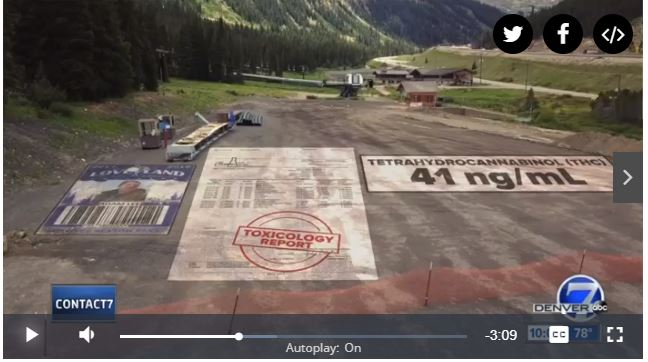
Mr. Lee became "caught" and was tragically crushed to death in a ski lift. The evidence of his marijuana use came from postmortem testing. A graphic in the Channel 7 video shows that the "high level" of THC found was 41 nanograms per milliliter. Remember, Colorado presumes impairment for drivers at 5 nanograms of THC per milliliter of blood. See C.R.S. 42-4-1301(6)(a)(IV) (2017). Channel 7 noted the intoxication conundrum, stating "that current science can't determine if Adam was impaired or intoxicated at the time of his death." But, its investigation does not discuss the 5ng/ml legal presumption, nor expound further on the 41ng/ml test result represented in the graphic. 

Courtesy Channel 7.

Perhaps the trial of this matter will include evidence on the type of testing (urine or blood), and an argument on whether that, or any, testing demonstrates "intoxication" or only "presence." There may be a discussion of the intent and meaning of the workers' compensation statute that says benefits will be reduced when such a test is positive. And, a potential argument about the perceived conflict between benefit reduction and the use of substances off the job.

Ms. Lee is quoted by Channel 7 as "frustrated" because her widow benefits have been decreased "because he smoked a legal substance." Of course, the Colorado Supreme Court has already cleared up that question. Despite what you may hear from conference presenters, marijuana is not "a legal substance." That Channel 7 provides no perspective on that fact is curious in a general sense, and more so in that this is billed as an "investigative" story. That Channel 7 leads its coverage with the "legal marijuana use" headline suggests either a lack of investigation by the station or that the reporting is instead tending toward advocacy of one perspective without mention of others. 

The station interviewed "an administrative law judge with Colorado’s Department of Labor," John Sandberg. He stated, "as it stands now, with a positive test result, an employer has the right to reduce those benefits." Judge Sandberg conceded that the reduction of benefits in workers' compensation could be viewed as contradictory to Colorado's "legalized marijuana," and opined that is "a good social issue," one for "the general assembly." The interview is edited; if the judge pointed out the fact that the Colorado Supreme Court has clarified that pot is not legal, that was not included in the story. 

In the end, the workplace can be dangerous. That is the reason for workers' compensation to begin with. Workers should be able to engage in their trade or profession without fear of intoxicated or impaired co-workers. It is doubtful that anyone would seriously argue that allowing workers to drink or use drugs on the job is appropriate. The reporting ignores this parallel: alcohol is in fact "legal," alcohol is a drug, and a worker who tests positive for alcohol may see denial or reduction of benefits in workers' compensation. Despite the view reported by Channel 7, the legality of weed may not be the critical point. 

The complexity of marijuana may instead be in whether "presence" or "intoxication" is the issue. Dealing with the fact that marijuana's presence can be detected for many days renders this topic potentially difficult in its own right, and different from substances like alcohol and other drugs with which science supports presence equaling impairment. However, the fact that Colorado law has equated a level or presence (5ng/ml) with impairment may be critical if the levels reported in the Channel 7 video (41ng/ml) are accurate (eight times the presumptive threshold). 

Despite that distinction, it appears that generally, the "presence" of drugs at the time of an accident can result in denial or reduction of workers' compensation, perhaps regardless of "impairment." The various laws cited by Lexis seem to support this conclusion is possible in a variety of states. This seems true of alcohol (legal), cough syrup (legal), prescription medication (legal) or pot (not legal, anywhere in America, despite what ill-informed conference pundits tell you). 

Awareness is a potential factor. Channel 7 asked Ms. Lee how many Colorado workers she thought were aware that smoking dope could put "their families at risk?” She opined "I imagine none of them do!” That is lamentable. It is acknowledged that few workers have a significant understanding of workers' compensation until an injury or illness occurs. Certainly, a greater understanding would be beneficial, but is it a realistic expectation? Perhaps most of us live life believing that "it will never happen to me?"

And, it is possible that awareness is not the issue. It seems likely in 2018 that everyone knows of the penalties for DUI, and yet Florida had 24,334 DUI convictions last year. In Florida, even police officers who know the law have been accused. Of course, some may feign ignorance, like the man who recently claimed he was not "drinking and driving" as he only took sips when the car was not in motion. However, the volume of DUI convictions may suggest that awareness of potential penalties may not necessarily prevent consumption. However, it may be that there is always room for greater awareness? 

The Lee matter is currently scheduled for a hearing before a Colorado "administrative law judge in the coming months." I am confident that the presiding judge will not be Judge Sandberg, who already spoke to the press on the record about the law that may be argued in the case. In the end, we will perhaps learn if "presence" or "intoxication" is the standard in Colorado. If intoxication is the issue, we may learn about the science behind thresholds like the 5ng/ml driving presumption which the news reports did not mention. 

We will see if the workers' compensation system upholds the statutory reduction of benefits, either because of that law and despite the decriminalization, or concludes that the right to smoke pot preempts the workers' compensation law. It is also possible that the Colorado workers' compensation system will address the continuing misconception that marijuana is legal.


Tuesday, July 17, 2018

All-too-Common Problem and a Novel Solution

In May 2018, WorkCompCentral reported the Iowa Commission to Fine Parties to Last-Minute Work Comp Settlements. The story emanated from a publication and order of the Iowa Division of Workers' Compensation. The fine looks like a sanction, in fact, it is referred to as such in the publication that precedes the order. 

The new process is set to begin July 1, and will require a monetary fine from parties to a case "where settlements are reported to the Division less than 24 hours before the scheduled start time of the hearing." It is not inconsequential; the fine is $300.00. The process was adopted based upon the Iowa District Court system imposing a similar sanction. The publication explains that the Iowa Division has "recently experienced an increase in late settlements." These late settlements, it says, "strain" the State's "diminishing resources."

I recall a Florida Circuit Court judge from my youth, who had a similar antipathy to late cancellations regarding motion hearings. Attorneys were allowed to coordinate motion hearings on his calendar with the help of a judicial assistant. The assistant would ask each time for the title of the motion. If the answer was "motion to compel discovery" or anything suggesting a similar purpose, the assistant would warn "If you resolve the issue, you must cancel this hearing by 5:00 the day prior. If you do not, you must appear in person for the motion hearing even though the motion is resolved." 

I had the displeasure of sitting for fifteen minutes one afternoon with that judge. We (opposing counsel, the judge, and myself) amiably discussed baseball, the Florida Gators, and the weather. Counsel and I had resolved the issue in the motion, but we had done so the morning of the hearing. Our entreaty that we cancel and not waste the judge's time fell on deaf ears. Having failed to cancel the day prior, we wasted our time and client's money traveling to the courthouse, awaiting our turn, and discussing pleasantries for 15 minutes. The judge was fastidious in making sure we spent the full 15 minutes after we had already traveled and waited our turn in the anteroom. 

Note that I said "one afternoon." That never happened to me again. I may not be the brightest bulb in the box, but I do learn reasonably quickly. After that experience, I made my motion resolution efforts before the hearing day, and always reminded opposing counsel of the assistant's admonition and my prior experience of wasted time discussing pleasantries. I suspect that the judge did not hold many such hearings, but then I guess he did not really have to (lawyers do like to talk among themselves and his reputation on that cancellation got around fairly quickly). 

"But Judge," you say, "isn't it better to settle a case than try it?" There is support for that. There is great faith in the belief that a compromise crafted by the parties is better than an edict from the judge. The feeling is that people feel better when they contribute to the outcome, the solution, of their dispute. The mediators I have known are unanimous in their contention that both parties getting "something" and none getting "everything" is a "good resolution." And, mediation is said to be the best path to that outcome (of course those mediators are perhaps partial as that is the skill they have and employ?) And, no one is arguing that resolution is not a positive path, merely that timing is important and sooner is better than later. 

In Iowa, if a settlement is submitted within 24 hours, then a fine of $300 will be imposed. And, the "claims that have been assessed a late settlement sanction will not have the settlement approved until the sanction has been paid." To a great extent, I suspect that most of those fines will be paid by employer/carriers, whether they know it or not. That is, if negotiations continue into the 24-hour period, that "cost" is likely to be added to the settlement demand whether tacit or otherwise. 

That seems to be contemplated by the order, which requires 
"The sanction shall be assessed in equal proportionate shares against the claimant and the self-insured employer or the insurance carrier(s), unless the parties reach a different arrangement among themselves as part of the settlement for payment of the sanction."
The Iowa Division is striving to make sure everyone is informed of this new policy. It issued the May 2018 Order and published it on its website. And, it announced it plans to provide that order to all parties in contested matters when a hearing notice is issued with a date after July 1, 2018. I am confident that several penalties will be paid, word will spread, and lawyers will likely adjust their practices (as I did with the motion judge above). And, the Division has left itself some room to be lenient if it wishes, noting that the sanction may be waived if "good cause" is shown. 

What is not clear from the publication or order is how 24-hour notice is of benefit to the judges or the state. I have presided over a few cases in the last 16 years. Many times, I left work in the afternoon knowing that my docket the following morning had a specific number of "confirmed" trials. And, many times I found that by 9:00 that next morning all of them would have resolved. Even the ones that we were told the prior afternoon had "no chance of resolving." 

And, when that occurred, I still found plenty to do with my day. There are always motions and settlements and stipulations to review. There are always orders to draft, proof, and upload. Say what you want about this job, but don't ever imagine it is boring. It is never boring. So, I find myself wondering what benefit the 24-hour notice will serve. 

Of course, there is one instance in which that is obvious. In Florida, many judges travel to counties in their district and conduct trials. Those events are often an hour's drive or more from the district office. It is admittedly frustrating to drive, often fighting morning traffic, to a remote destination only to find that the lawyers have spoken and resolved the case "on the courthouse steps." That eventuality often results in essentially a lost half day of work, wasted on needless driving, traffic stress, and expense. In that context, knowing the day before would be helpful, and would perhaps increase efficiency. 

However, it would be really helpful if parties to litigation would endeavor to meet a deadline of thirty days before trial. If parties resolve issues or settle, and the OJCC will be notified thirty days before the scheduled mediation or hearing, then that appointment could potentially be used by some other parties for some other case. But, to afford someone else the use of that "cancellation" time, there is the need for due process and that includes an appropriate amount of notice. 

I have voiced this idea at many lectures over the years. I consistently hear that it is both unreasonable and unrealistic to expect the parties to resolve issues 30 days prior to mediation or trial. But, consider that such a 30-day deadline is no different, in fact, than the deadline of the actual mediation or trial. If you do not resolve issues or settle before trial, then the trial is convened. (Mediation is the same). That does not mean parties cannot still resolve or settle after trial, but the point of resolution is often that you are not put through the expense, risk, and stress of the mediation or trial. 

There is no difference between a deadline of August 2, 2018, and a deadline of September 2, 2018. Either could be the parties' "deadline."  One is earlier than the other, but each is merely an arbitrary date by which the work must be done. But, only if there is an effect given to that deadline. There has never been a deadline, that I know of, that was convenient. We all live with deadlines and most of us do not like them. We tend to put things off until the deadline (most college term papers are written the night before or the morning that they are due). So, perhaps the Iowa effort is simply to change the deadline. It changes the perspective of parties as to how much time they have. They used to think of trial time as a deadline and will now think of 5:00 the day before instead. Perhaps it will eliminate needless travel for judges, or otherwise facilitate better use of time and other resources (hearing rooms, court reporters, etc.). 

But, perhaps it is also a harbinger of better planning overall. Perhaps with the appropriate motivation, culture, and practice would change our actions so that better communication occurs earlier and late cancellations are reduced or eliminated? It will be interesting to see how the Iowa experiment turns out. Will the litigation process work more efficiently with earlier deadlines and a financial incentive? 

Sunday, July 15, 2018

Are You Innumerate?

Literacy is a topic that frequently garners attention. It is axiomatic that understanding how to read and write are important skills for members of society. A quick Internet search will yield many analyses and comparisons of literacy rates, comparing groups, nations, and even professions. Recently the British Broadcasting Service (BBC) published an article regarding a similar, but less publicized, concern of society: becoming innumerate. No, the opposite of innumerate is seemingly not numerate, though one thesaurus lists that as an antonym. 

The BBC argues that numerical proficiency is a societal imperative, and sounds the alarm regarding challenges that we face regarding mathematical ability. It notes that currently "most of us" are acquainted with and use math in our daily lives. We use it to "handle bank accounts, evaluate choices in the supermarket, make estimates, and spot errors." But, this is not the end of our engagement of numbers and math. The BBC contends we similarly engage "our number sense when we decorate a room, bake a cake, go out for a meal, or pop down to the shops."

The perceived problem is a diminishing societal mathematical knowledge or fluency, secondary to the tools now commonly at our disposal. As a society, it seems, we are increasingly reliant upon calculators, computers, and programs. We are devolving from mathematical proficiency in the "simple maths," and in our ability to conceptualize calculations and comparisons. 

The BBC argues that these skills are critical for us individually. It cites examples in which math knowledge are critical, including determination of the actual cost of a car (purchase versus lease, life-cost of fuel or maintenance, etc.), comparing prices, adjusting recipes to feed a particular number, and more. It contends that "numeracy is how we interpret and apply our mathematical knowledge to the world around us." Numeracy is "the confidence and skill to use numbers and mathematical approaches in all aspects of life," according to National Numeracy, a charity promoting awareness of and improvement in numeracy. It contends that numeracy compliments literacy, and that both "are needed to function fully in modern life." 

This topic caught my attention because I have spent many hours over the years dealing with lawyers on topics of math, particularly in the realm of calculating benefits, reducing sums to present value, calculating statutory penalties and interest, and more. Lawyers are perceived as notoriously poor at mathematics. A recent Above the Law post posits "We’ve long known that law is a refuge for people who are afraid of numbers." In the hours I have spent both learning and explaining math to lawyers, I have lamented that many do lack basic mathematical skills. As an aside, math has always challenged me personally, as have statistics, writing, and public speaking. I cannot think of anything that came to me naturally, that is without a great deal of effort and practice. 

The BBC contends that data supports poor numeracy skills influence people's lives. It suggests that there are both career impacts and health impacts. Examples include the inability to understand interest calculations, currency conversions, and even splitting a "bar tab with friends." Not only are people challenged with the calculation of product costs, but they are not appropriately prepared to compare effective costs, such as "between two mortgages or even two differently-sized cans of soda." Thus, as consumers, those who are innumerate face a series of challenges. Though the article mentions health impacts, there is little explanation. Perhaps, those effects might involve calculating daily caloric intake, body mass monitoring, blood pressure, etc. Though all of those are numeric, perhaps no one really does the math on them daily (sorry to those who think the calorie listings on restaurant menus will solve American obesity). 

The more imperative point, however, is that researchers believe that "the problem seems to be getting worse." Researchers have devised testing for "numeracy proficiency." They report that "scores of 16-65 year-olds in the US is significantly below average." This may be because schools are not emphasizing math, or perhaps the "new math" is not living up to the promises?

So, we are dependent on our smartphones in yet another way. That is troubling. But, furthermore, there is a promise of coming artificial intelligence, a more intrusive, intelligent, and pervasive invasion of technology than we have yet seen. The BBC quotes one scholar who believes that "we are close to the moment when machines will help not just with arithmetic calculations but with numerical reasoning.” The scholar quoted by the BBC notes that calculators have thus far replaced our need for many mental efforts. But, as yet, we have been required partners in the application of math to the problems that surround us in our daily lives.

Think of the car example above, not just comparing the monthly payment of lease versus buy, but the monthly cost based on fuel consumption, maintenance, etc. Today, you might use a calculator to reason that analysis. But, what if you could just ask "Siri, which car is the better option if I drive it for "x" years, an average of "y" annual miles?" What if Cortana could reply to such a query and ask "How much of "y" will be highway and how much city?" What if Alexa could reply and ask "Have you considered the insurance and storage (parking) costs? You should consider ride-sharing apps instead." Should Google suggest features and options to maximize vehicle enjoyment (radio, seat covers) or to minimize cost (mileage, maintenance schedule)? What will these AI components do for (to?) us?

An intriguing, but overly slapstick, film addressed this in 2006, Idiocracy (trailer here). In it, the hero (Luke Wilson) volunteers to be cryogenically, and experimentally frozen. When he awakens 500 years later, he discovers that "evolution" can work both ways. This "common Joe" soldier of the 21st Century finds himself the smartest person on the planet as a result of the devolution of mankind. It is dystopian and interesting, slapstick and sophomoric. But it does illustrate a potential seemingly alluded to by the BBC. 

Our world is evolving. The news prognosticates that calculators and phones have decreased our mathematical abilities already. Therefore, there is conjecture the challenges will be increasingly difficult for us. Because we are delegating so much to these machines, we are perhaps losing the impetus to either check the computer output or to challenge it. A professor told BBC that it is imperative that we understand more than the outcome or solution. It is perhaps critical that we "question where the figures come from.” That subject has been oft-studied as regards price tags, comparisons, and shopping, for example, see Psychological Studies on Pricing.

At least for now, the human must remain in the equation. A computer can seamlessly produce an invoice or bill, but the foundation therefore (setting up the formula, selecting the appropriate variables) must be verified by the human. The quoted professor notes "A waiter at a restaurant might hand your table the wrong bill," which a human could check, but artificial intelligence may not yet be up to that task (you know you had the "tofu surprise" selected because of the calorie count printed on the menu, but the bill presented is for an evil, callous, rib-eye steak with mashed potatoes). 

The "setup" of the problem (what is eaten) will drive the outcome (price billed), and in that computers could make ineffective selections. You know what you ate (trust me, eat tofu and you will know it, even if it is not a "surprise"), but the computer or AI does not. If the "setup" is thus flawed, then so will the outcome, or bill, be flawed. That's not because the math is wrong, but because the manner in which the equation is set up may be inappropriate for the issue that is to be addressed. 

The authors submit that we should address this societal concern in 3 steps. The first is relatively simple, personally decline to rely upon the calculator or smartphone. They suggest that we "do basic calculations in your head or on paper." Admittedly, that is a challenge for sum (sic) who have either not explored math or have had skills atrophy in the age of technology. Second, we must question numerical outputs such as statistics; there must be an intellectual effort focused on understanding the structure of equations and thereby the context of results. Finally, they suggest that we make conscious decisions about when and how computers might help us with understanding and appreciating numbers, and conversely when it remains appropriate for us to instead challenge our own grey cells. 

The contention is that we must not blindly rely upon the technology that affords us calculations and results. We must instead remain skeptical, "pitting quantitative analysis against what we’re told is true." The implications of reliance, atrophy, and ambivalence regarding math and numbers is purportedly as important as retaining our ability to read. And, given the ubiquitous nature of microprocessors in our lives, and the ever-evolving computer intelligence, perhaps we need to make these decisions sooner rather than later, while we are still smart enough to both want to and be able to?


Thursday, July 12, 2018

Statutory, Inherent, or Delegated Authority

They say that unwanted tasks roll downhill. Some in the military have even waxed poetic on the point. As Ella Fitzgerald sang, "Into each life some rain must fall," and that means we all get some tasks which we would perhaps enjoy less than others. But, I digress.

Does a Florida Judge of Compensation Claims have the authority to conduct proceedings, render findings, and determine the amount of attorney fees that are appropriate for a successful appeal of a workers' compensation matter? The quick answer is "certainly," and if you asked any grey-headed workers' compensation attorney that is the answer you would get. But if you asked "Where does that authority come from?" those attorneys might not respond so quickly. 

After some thought, it is likely that their authority would be the Florida Rules of Appellate Procedure, Rule 9.180, specifically (i)(3), which states:
"If the court determines that an appellate fee is due, the lower tribunal shall have jurisdiction to conduct hearings and consider evidence regarding the amount of the attorney fee and costs due at any time after the mandate is issued"
This post is largely about our constitutional republic and some constitutional constructs that are worthy of understanding. The power of government here comes from the people. Those powers not delegated to the United States by the Constitution, nor prohibited by it to the States, are reserved to the States respectively, or to the people." U.S. Const., Amend. X. Many powers have been assumed by the federal government nonetheless, pursuant to broad grants of authority such as the Interstate Commerce Clause, and the Necessary and Proper Clause. Some argue that its assumption of power has been inappropriate. Further, the U.S. Supreme Court has concluded and explained that the powers granted to each branch are similarly constrained by the Constitution, that there is a "separation of powers" under which each branch must mind its business, and avoid interfering with the responsibilities of other branches.

Thus, some powers and authority are left delegated to the states (the separation between federal and state authority is referred to as "federalism," a horizontal demarcation similar to the vertical demarcation that is "separation of powers"). More specifically even, the Florida Constitution declares "All political power is inherent in the people." Fla. Const. art. I, Sec. 1. And, the power of government "shall be divided into legislative, executive, and judicial branches." Fla. Const. art. II, Sec. 3. That section continues "No person belonging to one branch shall exercise any powers appertaining to either of the other branches unless expressly provided herein." Thus, "separation of powers" in the Florida Constitution is not an inference or interpretation, it is seemingly clear.

Separation of powers has been discussed in Florida workers' compensation. In 2004 that issue was critical when The Florida Bar Workers' Compensation Section asked the Florida Supreme Court to approve amendments to the Rules of Workers' Compensation Procedure. Those rules had been adopted by the Court in 1973, and for thirty years the process and procedure of workers' compensation litigation followed those rules. This is discussed further in Separation of Powers - An Interesting Analysis (February 2017).

Perhaps the most intriguing portion of the Court's 2004 decision is not the detailed explanation of how those Rules came to be, came to be endorsed by the legislature, and came to be accepted far and wide, though that is all interesting. Most intriguing, however, is the Court's conclusion regarding the separation of powers. Clearly, no judge of compensation claims is a "court," and as clearly only the courts are under the authority of the Florida Supreme Court. Noting that a Supreme Court that adopted and amended workers' compensation litigation rules for decades concluded:
"we find that this Court has no authority under the Florida Constitution, nor has this Court ever had the constitutional authority to promulgate rules of practice and procedure for this executive entity. (Emphasis added)."
In Hans Christian Anderson's The Emperor's New Clothes, everyone went along when the emperor thought he had clothes. It took a fresh look, a fresh perspective, a child, to say "But he hasn't got anything on." And similarly, it took the Division of Administrative Hearings enacting workers' compensation procedural rules in 2003 for a fresh look at the Supreme Court rules, and a realization that a multitude had blindly assumed the efficacy of the rules for three decades. 

Over those same decades, there have been various Florida appellate decisions that discuss the authority or jurisdiction of Judges of Compensation Claims (or "JCCs," formerly "Deputy Commissioners" and "Judges of Industrial Claims"). In 1983, the Florida Supreme Court concluded in Smith v. Piezo Technology, 427 So.2d 182 (Fla 1983):
"The deputy commissioner is vested only with certain limited quasi-judicial powers relating to the adjudication of claims for compensation and benefits." 
In 1999, the District Court reiterated that JCCs operate "under a grant of quasi-judicial power from the Legislature, supplemented only by rules of procedure applicable to it adopted by the Supreme Court." Alachua County Adult Detention Center v. Alford, 727 So.2d 388 (Fla. 1st DCA 1999). Supplemented by the rules that the Court later concluded it never had authority to promulgate. Deciding Alford, and other cases, even the First DCA never took issue with the separation of powers issue. 

In 2004, the District Court returned to the subject of JCC authority in Pace v. Miami Dade County School Board, 868 So.2d 1286 (Fla. 1st DCA 2004). The Court was direct, specific, and succinct: 
"A JCC has no authority or jurisdiction beyond what is specifically conferred by statute.” Farhangi v. Dunkin Donuts, 728 So.2d 772, 773 (Fla. 1st DCA 1999). “Unlike a court of general jurisdiction, a judge of compensation claims does not have inherent judicial power but only the power expressly conferred by chapter 440.” McFadden v. Hardrives Constr., Inc., 573 So.2d 1057, 1059 (Fla. 1st DCA 1991)."
So, we return now to Rule 9.180(i)(3), which says that "the lower tribunal" (in this context the JCC) "shall have jurisdiction," with "jurisdiction" meaning "authority." However, the District Court has been quite clear that the only authority of a JCC is "what is specifically conferred by statute.” So, accepting that this rule says there is jurisdiction and that this rule is not a statute, I reiterate the original question "Does a Florida Judge of Compensation Claims have the authority to conduct proceedings, render findings, and determine the amount of attorneys fees that are appropriate for a successful appeal of a workers' compensation matter?"

It would seem that if the answer to that question is "yes," then there must needs be a statute that says so. Smith, Alford, Pace, Farhangi, McFadden. Section 440.271 addresses the "appeal of order of" the JCC. There is nothing in that statutory section regarding the jurisdiction discussed in Rule 9.180(i)(3). Section 440.34 addresses "attorney's fees; costs." That section, 440.34(2), discusses consideration of the "benefits secured by the attorney," which might infer authority if it is the claimant who has prevailed upon appeal and thus, through appeal, "secured benefits." However, the section includes other language that seems far more related to the award of trial fees.

Section 440.34(5) is specific to appellate process. It provides that in the event of "proceedings" for "review of any claim, award or compensation order," then "the court may award the injured employee or dependent an attorney’s fee to be paid by the employer or carrier, in its discretion, which shall be paid as the court may direct." (Emphasis added). There is no language in this section that appears to afford a JCC any jurisdiction as seemingly described in Rule 9.180(i)(3). And, in light of the Supreme Court's clear enunciations in 2004, there remains no doubt that neither Judges of Compensation Claims nor the OJCC is a "court," and thus are not the subject of this subsection. 

And so, the question persists, "does a Florida Judge of Compensation Claims have the authority" to determine the fee amount on behalf of the appellate court, pursuant to its instruction and order?

There are those who would perhaps refer to Section 440.33(1), which says the JCC may:
"do all things conformable to law which may be necessary to enable the judge effectively to discharge the duties of her or his office"
The authority conveyed by this section has been the subject of various appellate decisions. See Horizon Healthcare v. Murphy, 660 So.2d 1065 (Fla 1st DCA 1995)(440.33(1)(supported the authority to impose sanctions); Delgado v. J.C. Concrete, 721 So.2d 353 (Fla. 1st DCA 1998)("grant protective orders and, conversely, motions to compel independent medical examinations"); but see Karell v. Miami Airport Hilton, 668 So.2d 227 (Fla. 1st DCA 1996)("the E/C can point to no specific statutory provision conferring this authority upon the JCC, they nevertheless argue that the requisite jurisdictional authority can be implied from several statutory provisions" including 440.33(1)).

Most would agree, that the Court has the authority to award a fee. Section 440.34(5) is seemingly clear and specific in that regard. But, the authority of a JCC to award an appellate attorney fee appears more elusive. Can an Article V. Florida Court delegate its authority to an executive branch official? The answer to that seems perhaps as clear as the Supreme Court's conclusion that the legislature may not delegate rule-making authority to the Court. Is the JCCs' jurisdiction actually "only the power expressly conferred by chapter 440" as the Court has repeatedly concluded, or is that jurisdiction subject to augmentation at the behest, the delegation, of the Court? In that regard, if the JCC acts beyond actual authority ("ultra vires"), then is the Court that directs that action an accessory?

And, with that, we end where we started. The question, it seems, remains "Does a Florida Judge of Compensation Claims have the authority to conduct proceedings, render findings, and determine the amount of attorney fees that are appropriate for a successful appeal of a workers' compensation matter?" The answer is not "yes" merely because "they always have." That answer is akin to your mom's "because I said so," it didn't work when you were a kid and it won't work now.

"Because they always have" was not a sufficient answer to the Court's rules of procedure or the emperor's new clothes, and it is not the answer here. The answer is seemingly not "yes" the Court can delegate its authority, as delegation perhaps violates the separation of powers. And so, the ultimate answer is "I don't know."

Of course, the practice may proceed for a variety of reasons. First, the Court has been ordering the process and following its appellate rule for years. The Court believes it may delegate, and that the Court has virtual exclusive appellate jurisdiction over workers' compensation cases. Recently, in Abuse of Discretion (June 2018), I noted how even intermediate appellate courts could be the final word, infallible because they are last. Second, the current practice is expedient, and the Florida Supreme Court has exalted expediency over construction at least once, see Castellanos v. Next Door Company. 192 So.3d 431 (Fla. 2016). Finally, of course, the question would never be reviewed unless some party or some First District Judge raised it. In light of the years of habit, and the expediency, each of these is doubtful.

If the question were ever raised, and the Court concluded it has enforced an inappropriate paradigm for years, the effect would have to be addressed. In 2004, the Florida Supreme Court was aware of that and included in its Rules abrogation a limitation that the decision would only apply prospectively, to the future and not the past. The Court explained that this would prevent "an upheaval of decades of workers' compensation law." The Court, in correcting its misstep, prevented upheaval and consequence of its perception and rule imposition.

It is an intriguing question, "can a JCC award an appellate attorney fee." It is the sort of thing a law professor might enjoy tormenting a class with. It is a curiosity, a conflict, and a puzzle. And, in the end, the answer remains "I don't know," which did not satisfy Mr. Hand (oblique reference Fast Times at Ridgemont High) and it may not satisfy you. But, as they say, it is what it is until some higher court says it isn't.